
Looking for the juwai teer previous result from a past date can feel confusing when you land on a page full of numbers and dates. This guide explains exactly how the Juwai teer previous result archive works, how to read the juwai teer result list, how to find a juwai old teer result by date, and how to understand a juwai teer chart without mixing up rounds, sessions, or dates. Everything here is built around real, practical information, and you will not find any invented numbers or predictions in this article.
Before we start, one important note. Teer is a legal lottery game in Meghalaya, organized under the Meghalaya Amusements and Betting Tax Act. It is meant for adults who are 18 years and older, and everyone should play responsibly.

What Is a Juwai Teer Previous Result
A juwai teer previous result is simply the recorded outcome of a Juwai teer round that was declared on an earlier date. Every day the Juwai teer game holds two main rounds, called the First Round (FR) and the Second Round (SR). Once each round is declared, the outcome is recorded and becomes part of the historical record. When people search for a juwai teer previous result, they are usually looking for one of three things: the result from yesterday, the result from a specific past date, or the full history of results over weeks and months.
The word “previous” matters here because teer results change every single day. Today’s result is only useful until tomorrow’s game is declared. After that, it joins the archive. Sites like Teer Results keep these records so that visitors can always look back at any date they need.
Why Previous Results Matter to Visitors
People look up a juwai teer previous result for many legitimate reasons. Some want to confirm the number they saw announced at a ticket counter. Others keep personal records of the days they played and want to cross-check their notes. Some visitors are researchers or writers studying the game, and a few simply want to understand how the archive works before they rely on it. In all these cases, the archive is a record-keeping tool, nothing more.
It is important to say this clearly. Previous results cannot tell you what will happen in future rounds. The teer game is a game of chance, and each day’s round is independent of the days before it. This article will never use the archive to suggest future numbers, because that would be prediction content, and predictions are not reliable information.
Juwai Teer Previous Result vs Today Result
One of the most common mistakes new visitors make is mixing up the previous result with today’s result. The difference is simple, but on a busy results page it is easy to get confused, so let us make it very clear.
Today’s result is the outcome of the most recent rounds that have already been declared today. A juwai teer previous result is the outcome of rounds declared on an earlier date. When you look at a juwai teer result list, the rows are usually sorted with the newest date at the top and older dates below it. The top row shows the latest declared rounds, and everything under it is previous result history.
If you open a results page late in the evening, you will normally see today’s complete FR and SR outcomes. If you open it early in the morning before today’s rounds are declared, the top of the list will still show yesterday’s result. In that situation, yesterday’s result is technically the juwai teer previous result relative to today, even though it is the most recent record available. Always check the date shown next to the numbers before you use them.
First Round and Second Round in the Archive
Every archived date in the Juwai record contains two results: one for the First Round and one for the Second Round. The First Round is declared earlier in the day, and the Second Round is declared later. In the archive, each date row will show both numbers side by side once both rounds for that day are complete.
Sometimes you may see an archive row where only the First Round is filled in and the Second Round column shows a placeholder like “-“. This does not mean the result was skipped. It usually means the record was captured between the two declarations, or the second round had not yet been declared at the time the archive entry was created. The missing value gets filled in once the Second Round is declared.
How to Read the Juwai Teer Result List
The juwai teer result list is the main tool you will use to browse previous results. It is a simple table-style listing where each row represents one date, and the columns show the First Round and Second Round outcomes for that date. Learning to read this list correctly takes less than a minute, but doing it wrong can lead you to the wrong date, so here is a careful walkthrough.
Columns You Will See
A well-organized juwai teer result list has at least three columns:
- Date: the calendar date the rounds were declared on. This is the column you must always read first.
- First Round (FR): the outcome of the day’s first round, shown as a two-digit number.
- Second Round (SR): the outcome of the day’s second round, shown as a two-digit number.
Some lists also show a serial number column or a day-of-week column. These are just helpers. The three columns above are the essential ones. If a site shows extra columns, they are for convenience, not for additional rounds.

Reading Direction: Newest First
Archive lists are normally ordered with the newest date at the top. This is the opposite of how we read a book, and it trips up beginners. When you open the list, start at the top and move downward to go further back in time. If you want last week’s result, scroll down about seven rows. If you want a result from last month, keep scrolling until the date column matches the date you need.
What the Placeholder “-” Means
You will often see a dash “-” in the archive instead of a number. This is a placeholder, and it has a specific meaning depending on where it appears:
- In a future date row, it means the round has not been declared yet.
- In a row between FR and SR declarations, it means the second round is still pending.
- In very old archive rows, it can mean the record for that date is unavailable.
The dash is never a real result. If someone quotes a dash as if it were a number, they are reading the list incorrectly.
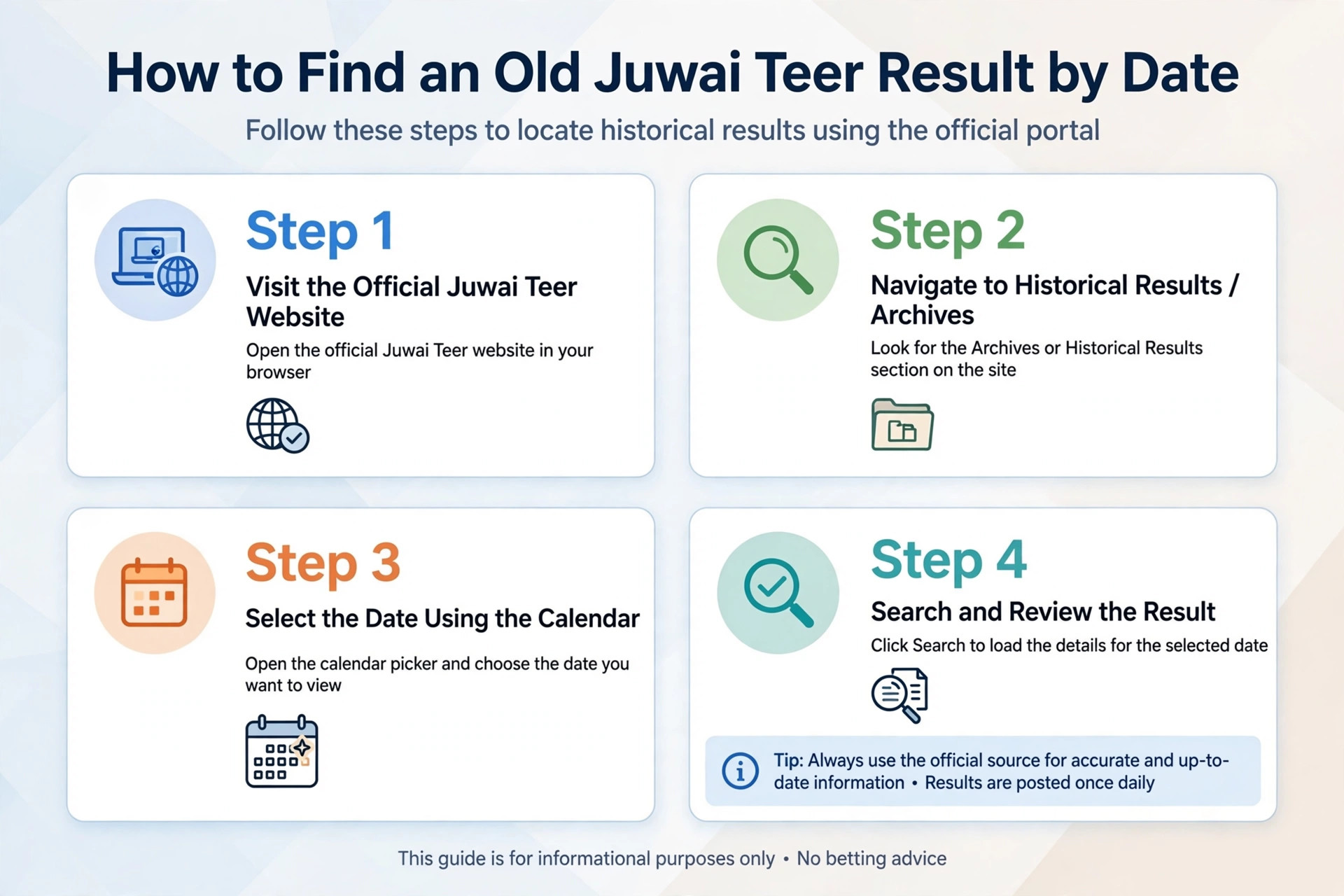
How to Find a Juwai Old Teer Result by Date
Finding a juwai old teer result from a specific past date is the most common archive task. Here is a reliable step-by-step method that works on any well-maintained archive page, including the archive on Teer Results.
Step 1 – Open the Juwai Archive Page
Start on a page that is dedicated to Juwai results or to the full result archive. On Teer Results, the Juwai teer result page and the teer result list page are the right places to begin. Make sure you are looking at Juwai records and not Shillong or Khanapara records, because each market has its own archive.
Step 2 – Locate the Date Column
Once the list loads, find the date column. Confirm that the dates are written in the format you expect. Most Indian result archives use the DD-MM-YYYY format, but some use YYYY-MM-DD. Knowing the format prevents you from reading a date backwards.
Step 3 – Search or Scroll to Your Date
If the page has a search or filter box, type the date you want. This is much faster than scrolling through months of rows. If there is no search box, use your browser’s find function (Ctrl+F or Cmd+F) and type the date. The browser will jump straight to the matching row.
Step 4 – Read Both Rounds for That Date
Once you find the date row, read the First Round and Second Round values for that date only. Do not read the row above or below it by accident. Double-check that the date in the row matches the date you wanted, especially around month boundaries where it is easy to slip one row.
Step 5 – Note the Session
Juwai also runs a morning session on some days. If you are looking for a morning result, make sure you are reading the morning archive section and not the day session archive. The Juwai morning teer result page covers the morning session separately. Mixing the morning and day archives is one of the most frequent sources of confusion.
Understanding the Juwai Teer Chart
A juwai teer chart is just another way of presenting the same archive data. While a result list shows dates in rows with FR and SR columns, a chart often presents the data in a more compact grid, sometimes organized by week or by month. The underlying information is identical: each date has a First Round and a Second Round outcome.
Chart vs List: Which Should You Use
The choice between a chart and a list is purely a matter of convenience:
- Use the list when you want to find a specific date quickly, because lists are easier to search with Ctrl+F.
- Use the chart when you want to scan a whole month at a glance, because charts fit more dates on one screen.
Neither format is more accurate than the other. They are two views of the same archive. If the numbers ever disagree between a chart and a list on the same site, treat the dated list as the primary reference and check the date carefully, because charts are more prone to alignment mistakes when a month has an irregular number of days.
How Chart Rows Are Organized
In a typical juwai teer chart, each row covers one date, and the two result columns sit next to the date. Some charts group rows by week with a week label, and some show a full month in one table. A few charts color-code the cells, but the colors carry no official meaning; they are just visual design. Always read the date first, then the numbers, and ignore the colors.
Monthly and Weekly Views
Long-term archives are sometimes split into monthly pages so that a single page does not become too heavy to load. If you need a result from three months ago and the current archive page only goes back six weeks, look for month navigation links, usually labeled with month names or shown as “Previous Month” buttons. Weekly views are less common but appear on some sites as a compact seven-day summary.
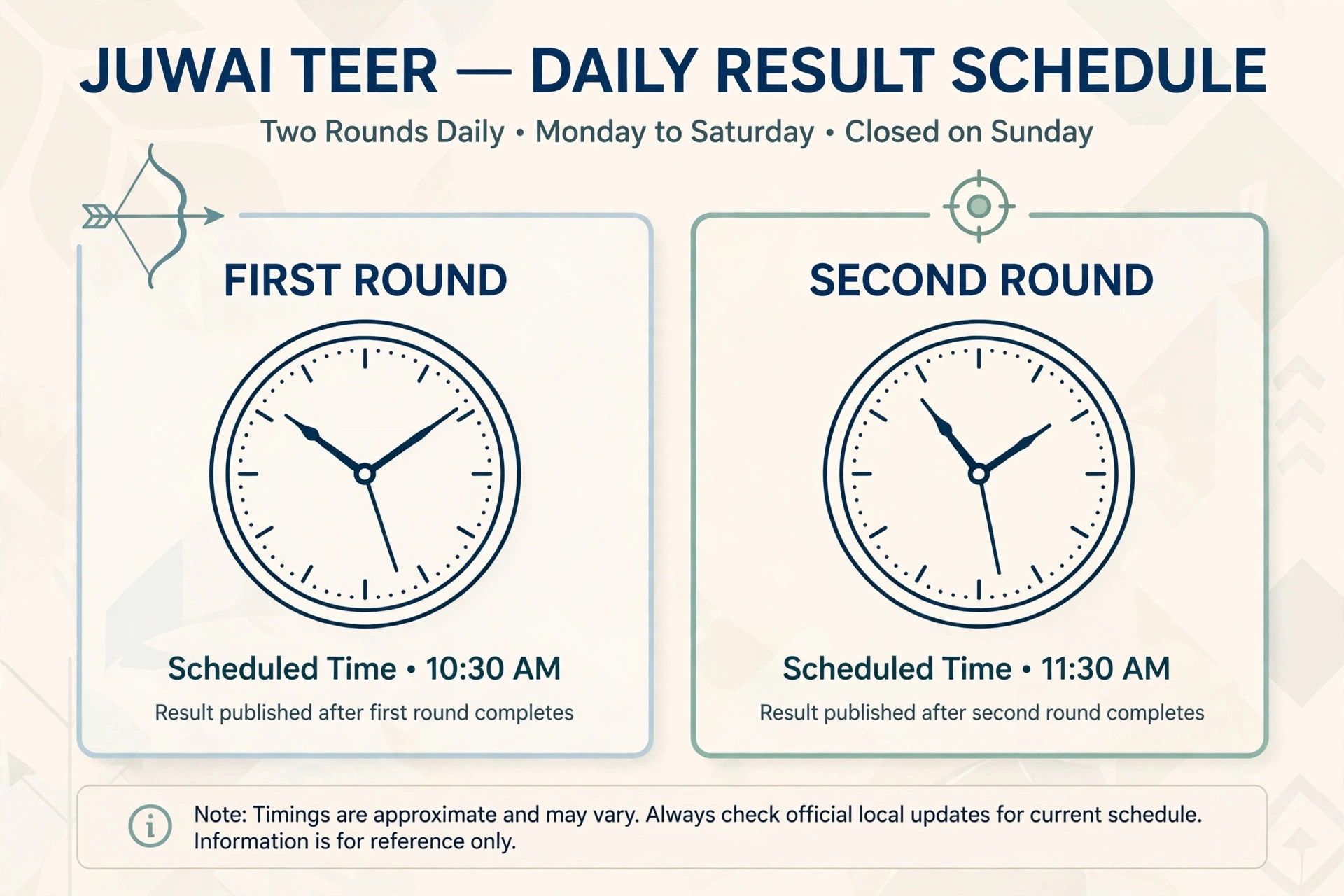
Juwai Teer Result Schedule and Declaration Timing
Understanding the daily schedule makes the archive much easier to read, because you will know when a “previous” result becomes the current one and when new rows appear.
The Two Daily Rounds
Juwai teer is played in two rounds each day. The First Round is declared in the afternoon, and the Second Round is declared later in the evening. The exact clock time can shift slightly from day to day depending on local conditions at the archery ground, but the order never changes: FR first, then SR.
When New Archive Rows Appear
A new row for today typically appears in the archive once the First Round is declared. At that point the row shows today’s FR outcome and a placeholder for the SR. The SR value is filled in after the second declaration. This means that if you check the archive between the two rounds, you will see a half-complete row for today. That row is not a previous result yet; it is today’s result in progress. It only becomes part of the previous result history once the day is over and a newer date takes the top position.
Days With No Game
Teer is not held every single day of the year. Sundays are traditionally a rest day for the game, and there are occasional holidays when no rounds are declared. On these days, the archive will show a gap: no new row appears for that date. A gap in the archive is normal and expected. Do not treat a missing date as a lost or hidden result; it simply means no game was held that day.
Juwai Teer Previous Result for Yesterday and Last Week
Many visitors do not need a deep archive at all. They just want yesterday’s result or the results from the last few days. Here is how to handle these short-range lookups.
Finding Yesterday’s Result
Yesterday’s juwai teer previous result is the second row in a newest-first list when today’s rounds are complete, or the first row when today’s rounds have not started yet. The safest method is to read the date column rather than counting rows. Find the row whose date is yesterday’s date, and read its FR and SR values. This avoids mistakes on days when the game was not held, because row-counting breaks down whenever there is a gap.
Finding Last Week’s Results
For a seven-day range, scroll down until you reach the date from seven days ago. Read each row between today and that date if you need the full week. If you only need one specific day from last week, use the browser find function with that date, as described in the search steps above.
Cross-Checking With a Second Source
If a result matters to you, for example you are confirming a ticket, it is good practice to cross-check the number against a second source. The archive on the Teer Results homepage shows the latest updates, and the dedicated Juwai pages show the full dated history. If both agree on the date and both rounds, you can be confident in the record. If they disagree, wait for the record to stabilize or check with the counter where the ticket was purchased.
Morning Session Previous Results
Juwai runs a morning session in addition to the main day session. The morning session has its own First Round and Second Round, declared earlier in the day, and its own separate archive. This is a point where many visitors go wrong, so it deserves its own section.
Morning and Day Archives Are Separate
The morning teer archive and the day teer archive are two different records. A juwai teer previous result from the morning session will not appear in the day session list, and vice versa. When someone says “yesterday’s Juwai result” without specifying the session, they usually mean the day session, but you should always confirm which session you need before you start searching.
How Morning Rounds Appear in the Archive
Morning archive rows look exactly like day archive rows: a date, a First Round, and a Second Round. The only difference is the session label on the page. On Teer Results, the Juwai morning teer result page carries the morning archive with its own date rows. If you land on a page and are not sure which session it shows, look at the page heading and the declaration times mentioned on the page before trusting the numbers.
Common Mistakes When Reading Old Juwai Results
Even careful readers make these mistakes. Knowing them in advance will save you from acting on the wrong record.
Mistake 1 – Reading the Wrong Market
Shillong, Juwai, and Khanapara each have their own archives, and their numbers are completely independent. A juwai teer previous result is not interchangeable with a Shillong previous result from the same date. Always confirm the market name in the page heading before you read any numbers.
Mistake 2 – Mixing Up FR and SR Columns
The First Round and Second Round columns sit next to each other, and it is easy to read the wrong one, especially on a small phone screen. Before you note down a number, check the column header above it. FR and SR are different rounds with different outcomes.
Mistake 3 – Ignoring the Date Format
A date written as 05-06-2026 means the 5th of June in the DD-MM-YYYY format, but the 5th of an unknown reading in other formats. If the archive does not label its format, look at a row with a day number above 12, which can only be read one way, and use it to confirm the format for the whole page.
Mistake 4 – Treating the Placeholder as a Number
As explained earlier, a dash “-” is a placeholder, not a result. It appears for pending rounds and unavailable records. Never quote it or act on it as if it were a declared number.
Mistake 5 – Using Old Results to Predict New Ones
This is the most important mistake on this list. Past results describe what already happened. They do not influence what will happen in the next round. Any system that claims to derive future numbers from a juwai teer previous result is not based on how the game works. The archive is for record-keeping and verification, and this article will not present it as anything else.
How Teer Results Organizes the Juwai Archive
On this site, the Juwai archive is spread across a small set of pages so that each one stays fast and easy to read. Here is how they fit together.
The Teer Results homepage shows the latest declared results across all markets, which is the fastest way to see what was declared most recently. The Juwai teer result page focuses on the Juwai day session with its dated history. The Juwai morning teer result page covers the morning session separately. The teer result list page brings the archives together in one browsable list.
If you are new to the site, start with the homepage to see the latest update, then move to the Juwai page for the specific market, and use the result list page when you need to browse further back in time. Each page links to the others, so you can move between them without losing your place.
A Brief Background on Teer and Juwai
A short background helps new visitors understand what the archive actually records. Teer is an archery-based lottery game played in Meghalaya, a state in northeastern India. Archers shoot arrows at a target, and the number of arrows that hit the target determines the result. The last two digits of the total number of hitting arrows form the two-digit result for the round. This is why every teer result is a number between 00 and 99.
The game is organized under the legal framework of Meghalaya state. You can read more about the state itself on Wikipedia’s Shillong page, which describes the city where the game has deep cultural roots, and the official Meghalaya government portal carries information about the state’s administration and legal lottery framework. Juwai, also spelled Jowai, is a town in the West Jaintia Hills district of Meghalaya and hosts one of the game’s recognized teer counters alongside Shillong and Khanapara.
Because the result comes from a physical archery event, every declared number in the archive traces back to a real round played on that date. The archive is a record of those events, kept so that players and the public can verify what was declared.
Responsible Play Note
Teer is a form of lottery betting. It is legal in Meghalaya for adults aged 18 and above, and it should always be treated as entertainment, not as a way to earn money. Set a strict budget before you play, never chase losses, and never borrow money to buy tickets. If playing stops being fun, stop playing. The archive on this site exists to help you verify records, not to encourage more play.
Frequently Asked Questions
Where can I find the juwai teer previous result?
You can find the juwai teer previous result in the dated archive on this site. Open the Juwai teer result page or the teer result list page, then look for the date you need in the date column and read the First Round and Second Round values for that row. For morning session records, use the Juwai morning teer result page instead.
What is the difference between the juwai teer result list and the juwai teer chart?
They show the same archive data in different layouts. A juwai teer result list shows one date per row with FR and SR columns, which makes it easy to search for a specific date. A juwai teer chart shows the same data in a more compact grid, which makes it easy to scan a whole month at a glance. Neither is more accurate; use whichever layout you find easier to read.
How do I find a juwai old teer result from a specific date?
Open the Juwai archive, then use your browser’s find function (Ctrl+F or Cmd+F) and type the date in the format the archive uses. The browser will jump to the matching row. Read the First Round and Second Round values for that date only, and confirm the date matches before you note the numbers down.
Why does the archive show a dash instead of a number for some dates?
A dash “-” is a placeholder, not a result. It appears when a round has not been declared yet, when the archive row was created between the First Round and Second Round declarations, or when no game was held on that date, such as Sundays and public holidays. It should never be read as a declared number.
Can I use the juwai teer previous result to predict tomorrow’s number?
No. Previous results are a historical record of rounds that already happened. Each teer round is an independent event, and past outcomes do not influence future ones. This site provides the archive for verification and record-keeping only, and it does not publish predictions, common numbers, or target numbers.
How far back does the Juwai teer archive go?
The archive keeps a rolling history of past results so that visitors can look up recent weeks and months. Older months may be organized on separate monthly pages to keep each page fast to load. If the current page does not go back far enough for the date you need, look for month navigation links on the archive page.
What should I do if two sources show different numbers for the same date?
First, confirm that both sources are showing the same market (Juwai, not Shillong or Khanapara), the same session (morning or day), the same date, and the same round (FR or SR). Most disagreements turn out to be one of these mix-ups. If everything matches and the numbers still differ, wait for the records to settle and cross-check with the counter where the ticket was bought.
Conclusion
The juwai teer previous result archive is a simple but useful tool: a dated record of every declared First Round and Second Round, organized so you can find any past date in seconds. Read the date column first, keep FR and SR columns straight, keep the morning and day sessions separate, and treat the dash placeholder for what it is. Use the archive to verify and to keep your own records, and remember that past results describe history, not the future. For the latest updates, visit the Teer Results homepage, and for deeper browsing, the teer result list page is always there when you need it.