Is Meghalaya Teer Legal? A 3-Line Legal Summary
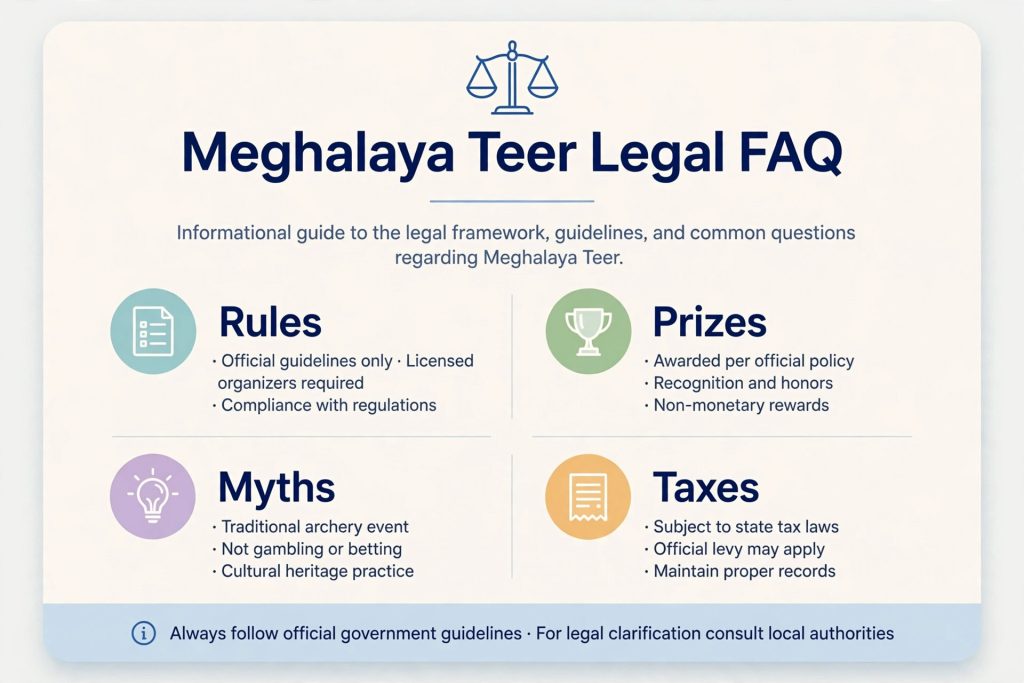
Few questions about the teer lottery meghalaya fans follow are asked more often than whether meghalaya teer is legal, so let us settle it in three plain lines before anything else. One, teer betting in Meghalaya is licensed under Section 14A of the Meghalaya Amusements and Betting Tax (Amendment) Act, 1982, and the later Meghalaya Regulation of the Game of Arrow Shooting and the Sale of Teer Tickets Act, 2018 further regulates the game and ticket sales. Two, that licence applies only inside Meghalaya and only to adults aged 18 and above buying tickets at licensed counters; outside the state, online play and unlicensed counters are not covered by this legal framework. Three, the game is conducted under the aegis of the Khasi Hills Archery Sports Association, so it is an organized archery-linked lottery with written rules, not a street gamble.

This guide is written for everyone who has heard a confident claim about teer rules, teer prize payouts, or the meghalaya teer act and wants to know what is actually true. We will walk through ten of the most repeated myths about Meghalaya teer and answer each one with facts, then give you a compact rules cheat-sheet, a general summary of prizes and tax, a responsible-play reminder, and a second block of extra frequently asked questions. If you mainly want to check the latest outcomes, our daily teer result listings are the quickest way to do that. Everything below is evergreen information about the legal framework. It is not betting advice, and no prediction or number-picking tips appear anywhere in this article.
The legal references used here are public documents you can read yourself. The text of the 1982 Act is available as a PDF on the official Meghalaya state portal, where Section 14A defines licensed bookmakers for arrow shooting and states that arrow shooting includes the game of teer. The broader national context, including how Meghalaya fits into it, is discussed in the Law Commission of India Report No. 276 on gambling frameworks, Meghalaya section.
10 Myths vs Facts About Meghalaya Teer
The internet is full of loud opinions about the meghalaya lottery, and most of them are wrong in the details. Below are the ten myths we see repeated most often, each answered with the fact that replaces it.
Myth 1 – Teer Is Illegal Everywhere in India
This is the single most common misunderstanding, and the answer to “is teer legal” depends entirely on where you are. Inside Meghalaya, teer betting is licensed under Section 14A of the Meghalaya Amusements and Betting Tax (Amendment) Act, 1982, a provision that defines licensed bookmakers for arrow shooting and expressly states that arrow shooting includes the game of teer. The Meghalaya Prevention of Gambling Act, 1970 gives the state government the power to exempt notified games, which is the legal route through which an archery-linked game can sit outside the general gambling prohibition. The Meghalaya Regulation of the Game of Arrow Shooting and the Sale of Teer Tickets Act, 2018 then adds a dedicated layer of regulation for how the game is organized and how teer tickets are sold. The Law Commission of India (Report No. 276) discusses exactly this framework, placing Meghalaya among the states that have carved out a regulated path rather than a blanket ban. The fact, therefore, is that Meghalaya teer is a licensed activity within Meghalaya and is not legal in states that have no such licensing framework. Anyone who tells you it is either illegal everywhere or legal everywhere is skipping the part that matters most, which is the state boundary.
Myth 2 – Anyone Can Set Up a Counter and Sell Teer Tickets
No. Selling teer tickets is a licensed activity, and the licence is the whole point of the legal structure. Section 14A of the 1982 Act defines licensed bookmakers, and the 2018 Act specifically regulates the sale of teer tickets, which means ticket sales are meant to happen through authorized counters under an organized framework rather than through whoever decides to print slips. A random shop counter, a street vendor, or a messaging-group seller has no licence under these Acts, and buying from them gives you none of the protections or accountability the licensed system is built around. If you are ever offered tickets in a setting that does not look like an authorized counter, treat that as a warning sign rather than a bargain. The licensed model exists precisely so that the state knows who is selling, where the money flows, and that the game follows the rules.
Myth 3 – Online Teer Sites Are Licensed to Take Your Bets
This myth costs people real money, so it deserves emphasis. The licensing framework described in the 1982 and 2018 Acts covers the physical, counter-based game in Meghalaya, and there is nothing in these Acts that extends a teer ticket licence to a website or app accepting bets from anywhere in the country. An online platform that claims to be a licensed teer counter, collects money through digital payments, and promises winnings is operating outside the framework described above. To be completely clear about our own role, information sites like ours only publish results and explain the game; we do not sell tickets, accept bets, or handle money, and you can read more about what we do on our about page. The safe rule is simple. Tickets come from licensed counters in Meghalaya, and any site that asks you to pay it for teer numbers should be treated with extreme caution.
Myth 4 – Minors Can Play If Their Parents Allow It
Parental permission does not change the legal position. Teer is a legal lottery in Meghalaya for adults 18 and above only, and a minor playing “with permission” is still a minor playing a licensed betting game. Licensed counters are expected to serve adults, and families should treat teer the same way they would treat any other age-restricted activity. If you are under 18, the correct answer to any invitation to play is no, regardless of who is offering. Parents sometimes assume that a small stake makes it harmless, but the law draws the line at age, not at the size of the bet. Keeping minors out of the game also protects the credibility of the licensed system, because age enforcement is one of the clearest visible signs that counters are operating within the rules.
Myth 5 – Teer Results Can Be Predicted With Secret Formulas
No formula, chart, dream book, or paid tipster can predict the result, and anyone selling predictions is selling fiction. Here is how the game actually works. Archers shoot arrows at a target, and bettors choose a number from 0 to 99 that represents the last two digits of the total arrows hitting the target. Two rounds per session are called the first round (FR) and the second round (SR). The outcome is produced by human archers in real time, which means it depends on physical performance on that day, not on a pattern you can decode from previous days. Every so-called number prediction system you see online is numerology dressed up as analysis. There is no mathematical way to know in advance how many arrows will strike the target in a given round, so no prediction method can beat simple chance. The honest version of this game is simple. You pick a number between 0 and 99, the archers shoot, and the last two digits of the arrows hitting the target decide the round. If a result sheet shows, for example, a placeholder like “-” (example only, not a real result), that is just the format, two digits, nothing more mysterious.
Myth 6 – Teer Winnings Are Tax Free
Lottery-style winnings are not automatically tax free in India, and teer winnings are no exception to the principle that income can attract tax. Speak to the subject only in general terms, because tax rules change and this article is not tax advice. Winnings from games of this type may be taxable under Indian income tax law, and the practical guidance is to check the current rules, keep your ticket receipts and a record of what you won, and consult a tax professional if your winnings are significant. Do not rely on a counter agent, a social media post, or a friend’s guess about whether tax applies. The responsible approach is to assume that winnings count as income unless current law clearly says otherwise, and to verify that position with someone qualified. Never invent a rate in conversation either. Quoting a percentage you heard somewhere is how myths like this one keep spreading.
Myth 7 – Teer Tickets Work Anywhere in India
The licence that makes Meghalaya teer legal stops at the state border. The Acts discussed above are Meghalaya state laws, and they authorize a licensed game inside Meghalaya. Buying or selling teer tickets in another state does not carry that licence with it, and claiming otherwise is exactly how unlicensed operations dress themselves up. This is also why counters cannot legally be franchised across state lines on the back of a Meghalaya licence. If you live outside Meghalaya and someone offers you teer tickets “under the Meghalaya licence,” understand that the licence does not travel with the ticket. The legal game exists where the licensed counters exist, which is in Meghalaya.
Myth 8 – Teer Counters Keep No Records
The opposite is closer to the truth for licensed operations. A licensing system only works if the state can see what licensed bookmakers are doing, and the 2018 Act’s regulation of ticket sales exists precisely to keep the game organized and accountable. Licensed counters operate within a framework that expects order, receipts, and identifiable sellers, which is why the law defines who a licensed bookmaker is in the first place. From the player’s side, the smart habit is to always take and keep your ticket. Your ticket is your proof of purchase, and if anything about a payout ever needs to be checked, the ticket is what ties your number to that round. An operation that refuses receipts or sells on verbal promises is already signaling that it is not the licensed system the Acts describe.
Myth 9 – Teer Is Pure Luck With No Real Rules
Teer certainly involves chance, but calling it ruleless is wrong. The teer rules include the two-round structure (FR and SR), the 0 to 99 number format tied to the last two digits of arrows hitting the target, licensed bookmakers defined under Section 14A of the 1982 Act, ticket sales regulated under the 2018 Act, and conduct under the aegis of the Khasi Hills Archery Sports Association. That is a rulebook, not a free-for-all. The presence of rules is also what separates the licensed game from illegal gambling operations that copy its name. When people say teer has no rules, they usually mean they do not know the rules, which is a very different statement. Knowing the actual framework helps you recognize when something claiming to be teer is breaking the pattern, such as a third round that does not exist or a number format outside 0 to 99.
Myth 10 – The Government Gets Nothing From Teer
This myth usually comes from people who assume that because teer looks informal, it must be invisible to the state. In reality, the whole point of the 1982 Act is right there in its name. It is an amusements and betting tax law. Licensing the game brings it into a tax and regulatory framework, which means the activity is formally recognized, supervised, and taxed rather than driven underground where the state sees nothing. The 2018 Act adds dedicated regulation of the game and ticket sales on top of that. Whatever one thinks of the policy, the structure is designed so that a regulated, licensed game contributes to public revenue through the tax system while an unlicensed copy contributes nothing and carries legal risk for everyone involved. The government does not license things it gets nothing from. The licence is the mechanism.
Meghalaya Teer Rules Cheat-Sheet
For quick reference, here is the whole framework on one short list. Who can play: adults aged 18 and above only. Where: licensed counters in Meghalaya. What you pick: one number from 0 to 99. What it means: your number represents the last two digits of the total arrows hitting the target in that round. How many rounds: two per session, the first round (FR) and the second round (SR). Who licenses it: licensed bookmakers defined under Section 14A of the Meghalaya Amusements and Betting Tax (Amendment) Act, 1982. What else governs it: the Meghalaya Regulation of the Game of Arrow Shooting and the Sale of Teer Tickets Act, 2018 for the game and ticket sales, with the general gambling position set by the Meghalaya Prevention of Gambling Act, 1970. Who conducts it: the game runs under the aegis of the Khasi Hills Archery Sports Association. What to keep: your ticket, always. What to avoid: online sellers, unlicensed counters, tickets sold outside Meghalaya, and anyone promising predictions.
Meghalaya Teer Prizes and Tax: A General Summary
The teer prize question comes up in almost every conversation about the game, so here is the general picture without invented figures. Prizes are paid as a fixed multiple of the stake, and the multiple is set by the licensed counter under the regulated framework. That means the payout structure is standardized for players at licensed counters rather than negotiated per ticket. This article deliberately does not state a specific multiplier as fact, because payout terms belong to the licensed operators and the current rules, not to a general guide. If anyone quotes you a specific multiple as though it were a national constant, treat that as a sales pitch, not a legal fact. On tax, keep the guidance from Myth 6 in mind. Winnings may be taxable under Indian income tax law, rules can change, and you should check the current position and keep records of tickets and winnings. For a rough sense of how seriously to take record-keeping, consider that even a modest daily habit adds up over a year, and organized records are the difference between guessing and knowing at tax time. Never let a prize claim pressure you into staking more than you planned. The prize is a multiple of your stake, which means the loss on a losing ticket is also real money, and that is the part people forget while staring at the payout.
Responsible Play and the 18+ Rule for Meghalaya Teer
Teer is a legal lottery in Meghalaya for adults 18 and above only, and the responsible way to treat it is as paid entertainment, not as income. Set a fixed budget before you play, stake only what you can afford to lose completely, and stop when the budget is gone. Never borrow money to play, never chase losses by increasing stakes, and never treat teer as a way to pay bills or clear debts. Keep it separate from essentials like food, rent, school fees, and savings. If playing stops being fun, if you hide it from family, or if you find yourself spending money meant for necessities, step back and talk to someone you trust. Families should keep minors away from counters entirely, since the 18-plus rule is both a legal requirement and a basic safeguard. The licensed game will still be there tomorrow. Your financial safety matters more than any single round.

Extra FAQs About Meghalaya Teer
What exactly is the Meghalaya teer act that makes the game legal?
There is no single one-line law. The framework has three main parts. Section 14A of the Meghalaya Amusements and Betting Tax (Amendment) Act, 1982 defines licensed bookmakers for arrow shooting and states that arrow shooting includes the game of teer. The Meghalaya Prevention of Gambling Act, 1970 lets the government exempt notified games from the general gambling prohibition. The Meghalaya Regulation of the Game of Arrow Shooting and the Sale of Teer Tickets Act, 2018 further regulates the game itself and the sale of teer tickets. Together they create the licensed system. The Law Commission of India (Report No. 276) discusses this framework in its survey of gambling law across India.
What do FR and SR mean in teer?
FR stands for the first round and SR stands for the second round. Each teer session has these two rounds, and each round produces its own result based on the archers’ shooting in that round. Bettors pick a number from 0 to 99 for a round, and the result reflects the last two digits of the total arrows hitting the target. The two rounds are independent, so the outcome of FR does not determine or influence SR. Sites that publish results list FR and SR separately for this reason.
How is the winning number actually decided?
By archers shooting real arrows at a target. After a round of shooting, the total number of arrows that hit the target is counted, and the last two digits of that total become the result for the round. Your ticket wins if the number you chose matches those two digits. There is no draw machine, no computer, and no committee choosing numbers. This physical process is also why prediction systems are meaningless. The result is decided by human performance in that round, and no chart of past results can tell you how many arrows will strike the target next time.
Can I buy teer tickets online?
Under the legal framework described in this article, teer tickets are sold at licensed counters in Meghalaya, and the Acts do not extend licensing to websites or apps. Any platform offering to sell you teer tickets online is operating outside the licensed system described above, regardless of what its marketing claims. Protect yourself by buying only at licensed counters and by treating online sellers as a fraud risk. Result information sites are a different category. They publish outcomes and explain the game but do not sell tickets or accept bets.
Can a tourist visiting Meghalaya play teer?
The age rule is the decisive factor. The game is for adults 18 and above, and a visiting adult buying a ticket at a licensed counter in Meghalaya is playing within the licensed system. A tourist should still follow every other rule on the cheat-sheet: licensed counters only, keep the ticket, no online purchases, and responsible stakes. Visitors should also remember that the licence does not follow them home. Taking the habit back to a state with no such framework means stepping outside the legal game.
What should I do if I lose my teer ticket?
Act immediately and go back to the counter where you bought it, because the ticket is your proof of purchase. A licensed counter operating within an organized system is your best chance of resolving the problem, since your purchase happened inside a regulated framework with identifiable sellers. This is exactly why Myth 8 matters. Buying from licensed counters and keeping receipts turns a lost ticket from a disaster into a solvable problem. Buying verbally from an unlicensed seller and losing the only proof you had is a much worse position, and there is no authority to appeal to.
Where can I find reliable daily teer results?
The fastest option is the complete teer result list on this site, which keeps FR and SR outcomes organized by date, or you can start from the Teer Results homepage for the latest updates. When you compare results across sources, look for agreement between them before treating any figure as confirmed, and remember that result sites publish outcomes only. They do not sell tickets and they do not predict numbers.

Why the Legal Details Matter for Ordinary Players
It is tempting to skip the law and just play, but the legal details are what protect you when something goes wrong. A licensed counter gives you a real ticket, an identifiable seller, and a framework to appeal to. An unlicensed seller gives you none of that, and the money you hand over is simply gone if there is a dispute. Knowing that the game is Meghalaya-only tells you that any cross-border offer is a red flag. Knowing that results cannot be predicted tells you that every paid tipster is a scam. Knowing that winnings may be taxable tells you to keep records instead of learning it the hard way later. The ten myths above survive because each one contains a grain of plausibility, but the facts are all public and all checkable in the Acts themselves. A player who knows the framework is a harder target for every scam built on these myths.
Conclusion
Meghalaya teer is a licensed archery-linked lottery in Meghalaya, governed by Section 14A of the 1982 Act and the 2018 Regulation Act, open to adults 18 and above at licensed counters, and organized around a simple, rule-bound format of FR and SR rounds with numbers from 0 to 99. Everything else, the myths about illegality everywhere, online licences, prediction secrets, tax-free winnings, and ticket sales beyond the state border, falls apart once you read the actual framework. Play only at licensed counters, keep your tickets, budget responsibly, and treat the game as entertainment. If anything in this guide raised a question we did not answer, contact us and we will look into it for a future update.