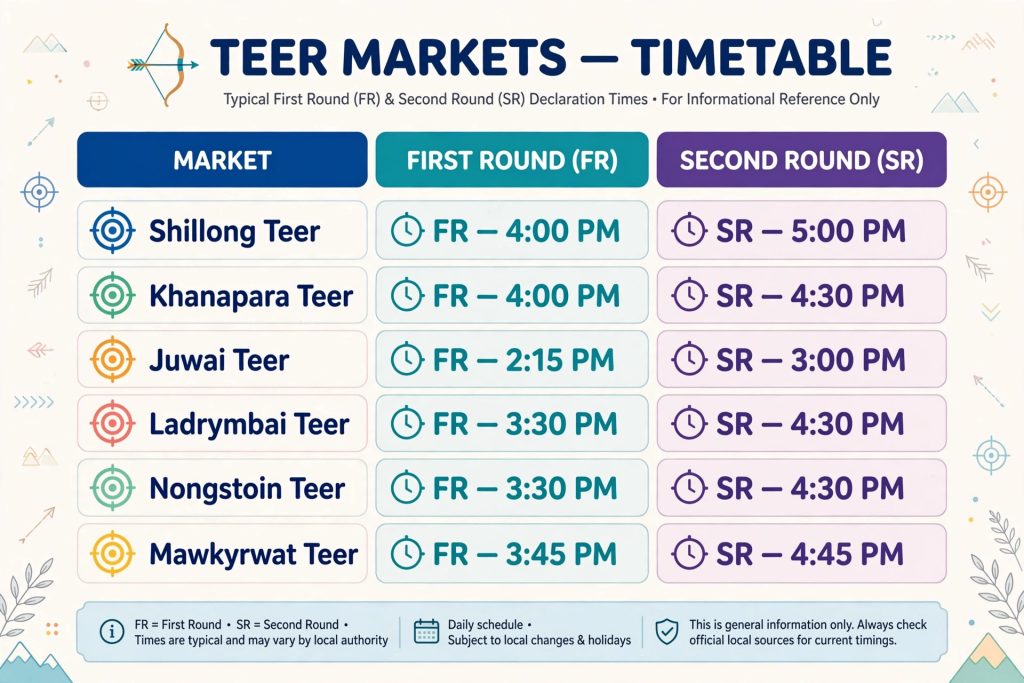
When you search for teer result time, you usually want one simple answer: what time is the result announced today? The honest answer is that teer result time is not one single clock time. It is a daily rhythm of archery rounds played across several markets in Meghalaya, each with its own First Round (FR) and Second Round (SR) declarations. This guide answers every timing question in one place, from the master teer result timing schedule to the edge cases people actually ask about, such as Sundays, delayed results and why two websites sometimes show slightly different times.
Teer is an archery based lottery held in Meghalaya. Skilled archers shoot arrows at a target, officials count the arrows, and the last two digits of the total become the winning number. Rounds are held from Monday to Saturday, and each market declares two results every game day: one for FR and one for SR. Because morning, day and night sessions run across Shillong, Juwai, Khanapara and other centers, the full teer result time map stretches from roughly 10:30 AM to roughly 9:30 PM Indian Standard Time.
Every time in this article is typical or approximate. Exact minutes can shift slightly by organizer and by day, and minor delays are completely normal. For the exact declaration on any given day, always check the live result cards on the daily teer result list instead of memorizing a fixed clock time.

Teer Result Time Master Schedule – Every Market at a Glance
The table below is the heart of this guide. It lists every major teer market and session with its typical FR and SR declaration times. Use it as your reference map, then read the sections below to understand the details behind each row.
| Market | Session | FR (typical) | SR (typical) |
|---|---|---|---|
| Shillong Morning | Morning | Usually around 10:30 AM | Usually around 11:30 AM |
| Juwai Morning | Morning | Usually around 10:30 to 10:40 AM | Usually around 11:30 to 11:40 AM |
| Khanapara Morning | Morning | Usually around 11:00 AM | Usually around 12:00 PM |
| Juwai (Day) | Afternoon | Usually around 2:30 PM | Usually around 3:00 to 3:10 PM |
| Shillong (Day) | Afternoon | Usually around 3:45 PM | Usually around 4:45 PM |
| Khanapara (Day) | Afternoon | Usually around 4:10 to 4:20 PM | Usually around 4:45 to 4:50 PM |
| Jowai and Ladrymbai | Afternoon | Usually around 4:45 PM | Usually around 4:50 PM |
| Shillong Night | Evening | Usually around 8:30 PM | Usually around 9:30 PM |
| Night Teer | Evening | Usually around 8:30 PM | Usually around 9:30 PM |
All times are Indian Standard Time, and all of these sessions run Monday to Saturday. Sunday is a holiday with no teer games at all.
Notice that some rows show a small range, such as 10:30 to 10:40 AM, while others show a single typical time. That is deliberate. Some organizers declare within a window of a few minutes, so the honest answer is a range. Others are consistent enough that a single typical time is more useful. Either way, treat these as strong expectations, not as promises down to the minute.
The table also shows the three daily waves of teer result timing clearly. The morning wave opens the day between roughly 10:30 AM and 12:00 PM. The afternoon wave carries the bulk of the famous markets between roughly 2:30 PM and 4:50 PM. The night wave closes the day between roughly 8:30 PM and 9:30 PM. If you only follow one market, you only need one row. If you follow several, this map keeps them straight.
Teer Result Time Today – How to Answer That Question Yourself
The phrase “teer result time today” is one of the most searched teer queries every single day, and it makes perfect sense. People do not want a generic schedule. They want to know what is happening right now. The good news is that once you understand the pattern, you can answer the question yourself in seconds without searching again.
Step 1 – Match your market to the right session
Start by identifying which market you follow. Shillong has morning, day and night sessions. Juwai has a morning session and an afternoon session. Khanapara has a morning session and an afternoon session. Each session has its own FR and SR, so “Shillong teer time” alone is not specific enough. Decide whether you mean morning, day or night first.
Step 2 – Work out whether FR or SR is due next
Look at the current time and compare it with the master schedule above. If the current time is before the typical FR time, the FR is the next result to expect. If it is after the FR time but before the SR time, the FR should already be declared and the SR is next. If it is after both typical times, the day’s results for that session are probably complete, unless there was a delay.
A concrete example helps. Suppose it is 4:00 PM on a weekday and you follow the Shillong day session. Shillong FR is usually declared around 3:45 PM, so the FR result should already be available. Shillong SR is usually declared around 4:45 PM, so the SR is the one to wait for. Another example: suppose it is 11:00 AM and you follow the Shillong morning session. Morning FR usually comes around 10:30 AM and SR around 11:30 AM, so the FR should be out and the SR is due in roughly half an hour.
Step 3 – Confirm on the live result cards
The schedule gives you expectations, but only the live result cards give you facts. Static articles, including this one, describe typical times. The actual declaration on any given day is what matters. When the expected time has passed and no result is showing, check today’s live result cards on Teer Results before assuming something is wrong, because a delay of ten or twenty minutes is common and does not mean the round was cancelled.
Shillong Teer Time – The Full Breakdown
Shillong is the flagship market and the one most people mean when they search for shillong teer time. It is also the only market with three full sessions in a day, so it deserves its own detailed breakdown.
Shillong morning teer time
The Shillong morning session is the first teer action of the day. The FR is usually declared around 10:30 AM and the SR usually follows around 11:30 AM. This session suits early followers who want their results before midday. Because it is the first session, any delay here is rarely connected to other markets. It runs on its own schedule.
Shillong day teer time
The afternoon session is the most famous one. Shillong FR is usually declared around 3:45 PM and Shillong SR usually follows around 4:45 PM. This is the session that generates the heaviest daily search traffic, and it is also the session where delays are most visible, simply because so many people are watching the clock at the same time.
Shillong night teer time
The night session closes the teer day. Shillong Night FR is usually declared around 8:30 PM and Shillong Night SR usually follows around 9:30 PM. Night teer is a fully regular session with the same FR and SR structure as the morning and day sessions, which we will address again in the myth busting section below.
Question: What time is Shillong Teer result today? The complete answer is that it depends on the session. Morning FR is usually around 10:30 AM and morning SR around 11:30 AM. Day FR is usually around 3:45 PM and day SR around 4:45 PM. Night FR is usually around 8:30 PM and night SR around 9:30 PM. All of these are Monday to Saturday, and none of them happen on Sunday. Once you know which session you follow, pick the matching row from the master schedule and then verify against the live result cards for the exact declaration today.

Juwai Teer Time and Khanapara Teer Time
Shillong gets most of the attention, but Juwai and Khanapara have large followings of their own, and their teer result timing has its own character. Getting these two right matters because their afternoon sessions sit close together on the clock and are easy to confuse.
Juwai teer time – morning and day sessions
Juwai runs two sessions. The morning session usually declares FR around 10:30 to 10:40 AM and SR around 11:30 to 11:40 AM, almost in parallel with the Shillong morning session. The afternoon session usually declares FR around 2:30 PM and SR around 3:00 to 3:10 PM, making Juwai the earliest of the afternoon markets. If you follow both Juwai and Shillong in the afternoon, remember that Juwai finishes well before the Shillong day session even begins.
Khanapara teer time – morning and day sessions
Khanapara also runs two sessions. The morning session usually declares FR around 11:00 AM and SR around 12:00 PM, slightly later than the Shillong and Juwai morning sessions. The afternoon session usually declares FR around 4:10 to 4:20 PM and SR around 4:45 to 4:50 PM. Notice how close the Khanapara afternoon SR sits to the Shillong day SR, which is usually around 4:45 PM. Followers who track both markets should be careful not to mix up these two separate results. Track both Khanapara rounds on the Khanapara teer result page.
Why is Khanapara later than Shillong?
This is one of the most common timing questions, and the answer is refreshingly simple. Shillong, Juwai and Khanapara are separate organizing centers with their own archery grounds, their own archers and their own counting officials. Each center sets its round times to suit its local schedule. There is no rule that says all markets must shoot at the same hour, and there is no master clock synchronizing them. Khanapara is later than Shillong in the afternoon simply because its organizers scheduled it that way, and the gap also helps followers track one market at a time instead of having every result land in the same minute.
Teer Result Timing – What Is the Gap Between FR and SR?
Every market declares two results a day, FR and SR, and newcomers constantly ask what the gap between them means. Understanding this gap clears up half of all teer timing confusion.
FR and SR are two separate rounds, not one result in two parts
FR stands for First Round and SR stands for Second Round. They are two completely separate archery rounds. Archers shoot, officials count, and a number is declared for FR. Then the whole process repeats for SR, and a second number is declared. Neither number is derived from the other. When you see a result card with two numbers, you are looking at the outcomes of two independent rounds played roughly an hour apart.
Why the gap is usually about an hour
The gap between FR and SR is usually around one hour in the main sessions. Shillong morning runs roughly 10:30 AM to 11:30 AM. Shillong day runs roughly 3:45 PM to 4:45 PM. Shillong night runs roughly 8:30 PM to 9:30 PM. Khanapara morning runs roughly 11:00 AM to 12:00 PM. The hour gives the ground crew time to complete the first round, count the arrows carefully, declare the result, reset the target area and then run the second round. Rushing this process would risk counting errors, and accuracy matters more than speed.
When the gap is shorter
Not every session uses a full hour. Juwai afternoon usually runs roughly 2:30 PM to 3:00 PM, about half an hour. Khanapara afternoon usually runs roughly 4:10 PM to 4:50 PM. Jowai and Ladrymbai are even tighter, with FR usually around 4:45 PM and SR around 4:50 PM. A shorter gap does not mean a less official result. It just reflects how each organizer structures its rounds. The key point is the same everywhere: FR and SR are separate rounds, and the gap between them is the time needed to run and count the second round.

Why Do Some Sites Show Slightly Different Teer Result Times?
Sooner or later every teer follower notices that two websites list slightly different times for the same market. One says Shillong FR is 3:45 PM, another says 3:40 PM, a third says 3:50 PM. This does not mean one of them is lying. There are several honest reasons for small differences.
Organizer schedules shift by a few minutes
The most common reason is the simplest. The actual shooting and counting schedule can move by a few minutes from day to day. An organizer might start five minutes late because of weather, ground preparation or a large crowd. Websites that track real declarations will therefore show slightly different typical times, because each one is summarizing what it has actually observed. A five minute difference between two sites is normal noise, not a sign of error.
A website’s timing page may be out of date
Some websites write their timing guide once and never update it. If an organizer permanently shifts a session by ten minutes, sites that refresh their pages will show the new time while stale pages keep showing the old one. This is why evergreen timing articles always say “typical” and “usually around.” When you see a meaningful difference, meaning more than ten or fifteen minutes, check which page was updated more recently and cross check with a live result card.
Announcement time versus counting time versus publishing time
There are actually three different moments hiding inside one phrase like “result time.” There is the moment the archery round ends, the moment the officials finish counting and announce the number, and the moment a website publishes it online. These can be several minutes apart. One site might define “result time” as the announcement moment and another as the publishing moment. Both are honest, and both can differ by a few minutes.
Time zone mix-ups
Teer times are always Indian Standard Time. Followers outside India sometimes convert incorrectly or read a time in their local zone without realizing it. If a time looks wildly off, like six hours early or late, it is almost always a time zone mistake rather than a real schedule difference.
Teer Timing Myths – Three Beliefs That Are Simply Wrong
Teer has been played for decades, and decades of word of mouth have produced myths that sound convincing but fall apart on inspection. Here are the three most persistent ones about teer result time.
Myth 1 – Results land at an exact second
Many newcomers imagine the result appears at precisely 3:45:00 PM like a train departure. In reality, teer result timing is the end point of a physical process. Archers shoot, every arrow is counted by hand, officials verify the count, and only then is the number declared. Each step takes a variable amount of time. That is why responsible guides say “usually around 3:45 PM” instead of “at 3:45 PM sharp.” Expecting second level precision will only cause frustration. Expecting the result within a reasonable window around the typical time is the right mindset.
Myth 2 – Night teer is unofficial
Because the night session is less famous than the afternoon session, some people assume it is informal or unofficial. It is not. Shillong Night and the other night sessions follow the same structure as every other session: a real archery round, official counting, an FR declaration and an SR declaration. The typical night teer result time of around 8:30 PM for FR and around 9:30 PM for SR is as regular as any daytime session. Night teer runs Monday to Saturday like everything else, and it takes Sundays off like everything else.
Myth 3 – Teer timing never changes
The opposite myth is that the schedule is carved in stone. Organizers do adjust session times over the years, sometimes by a few minutes and occasionally by more. Grounds change, daylight patterns shift with the seasons and local logistics evolve. A timing guide from three years ago may describe a schedule that no longer exists. Treat any teer result timing information as current knowledge rather than eternal law, and recheck the live cards whenever something looks different from what you remember.

Sunday, Holidays and Delays – Teer Timing Edge Cases
The schedule covers normal days. Real life also includes Sundays, public holidays and the occasional delayed round. Here is how teer result time behaves at the edges.
Is there teer on Sunday?
No. Sunday is a weekly holiday for teer across all markets. There are no morning, day or night sessions on Sunday, no FR and no SR. If you see a website claiming a Sunday teer result, treat it with deep suspicion, because it contradicts the standard weekly calendar that every major market follows. Use Sunday to review the week’s results instead of waiting for new ones.
Do morning and night sessions follow the same rules?
Yes. Every session, morning, day or night, follows the same fundamental rules. Two rounds are played, FR and SR. Arrows are shot and counted. The last two digits of the count become the result. Sunday is a holiday for all of them. The only differences between sessions are the clock times and the organizing center. There is no session with special scoring, no session with three rounds and no session where the rules of counting differ.
What time should I stop expecting a delayed result?
This is the most practical question in this whole guide. As a rule of thumb, if a result has not appeared within about one hour after its typical time, something unusual has happened and you should check for an official update rather than keep refreshing blindly. A delay of ten to thirty minutes is routine and needs no explanation. A delay approaching an hour suggests a genuine disruption, such as bad weather at the ground or a counting dispute. A delay beyond that, stretching into the next session’s window, usually means the round was postponed or cancelled for the day. Never assume a very late result will still arrive. Check the live cards, and if there is no update, wait for the next scheduled session instead.
Public holidays and special days
Beyond Sundays, teer may pause on major public holidays or days of local significance in Meghalaya. These pauses are not always announced far in advance on every website, which is another reason to check live result cards rather than relying purely on memory of the schedule. A blank result card on a holiday is normal, not a technical error.
How to Read a Teer Result When the Time Comes
Knowing the teer result time is only half the skill. The other half is reading the result correctly once it appears. Newcomers who want the full background on lottery games in India can read the Lotteries in India entry on Wikipedia, which explains the archery-based lottery format.
What FR and SR mean on a result card
A standard result card shows the date, the market name, the FR number and the SR number. Each number is the outcome of its own round. If a card shows FR as declared and SR as pending, it simply means the first round is done and the second round has not finished yet. Check back around the typical SR time.
Why results are always two digits
Teer results are always two digit numbers, from 00 to 99. This is because the result is the last two digits of the total arrow count. If a result card shows a placeholder such as “-” instead of a number, it means the result has not been declared yet. That placeholder is an example only, not a real result, and it is never a winning number. Do not try to interpret a dash as a clue. It is just the website’s way of saying the round is still pending.
Responsible Play and the Legal Standing of Teer
Teer is a legal lottery game in the state of Meghalaya, where it operates under state regulation. It is strictly for adults aged 18 and above. If you choose to participate, do so responsibly: set a firm budget, never chase losses and treat the game as entertainment, not as a source of income. Anyone under 18 should not participate at all.
For authoritative information about the state and its regulations, you can refer to the official Meghalaya government portal at https://meghalaya.gov.in/. That is the right place to verify the legal framework behind any lottery style game operating in the country. This article is an informational timing guide only. It contains no predictions, no number tips and no betting advice of any kind.
Teer Result Time – Frequently Asked Questions
What time is the Shillong Teer result declared today?
Shillong runs three sessions from Monday to Saturday. Morning FR is usually around 10:30 AM and morning SR around 11:30 AM. Day FR is usually around 3:45 PM and day SR around 4:45 PM. Night FR is usually around 8:30 PM and night SR around 9:30 PM. Match the current time to the right session, then confirm the exact declaration on the live result cards, because minor delays of a few minutes are normal.
What is the teer result timing for Juwai?
Juwai has a morning session and an afternoon session. Morning FR is usually around 10:30 to 10:40 AM and morning SR around 11:30 to 11:40 AM. Afternoon FR is usually around 2:30 PM and afternoon SR around 3:00 to 3:10 PM. The afternoon session is the earliest of all the day markets, finishing well before the Shillong day session begins.
What time does Khanapara Teer declare results?
Khanapara has a morning session and an afternoon session. Morning FR is usually around 11:00 AM and morning SR around 12:00 PM. Afternoon FR is usually around 4:10 to 4:20 PM and afternoon SR around 4:45 to 4:50 PM. Khanapara’s afternoon session runs later than Shillong’s because each center sets its own schedule independently.
Is there a teer result on Sunday?
No. Sunday is a weekly holiday for all teer markets, including Shillong, Juwai and Khanapara. There are no FR or SR declarations on Sunday. Any site showing a Sunday result should not be trusted.
What is the gap between FR and SR in teer?
The gap is usually around one hour in the main sessions, for example roughly 3:45 PM to 4:45 PM for the Shillong day session. Some sessions are tighter, such as Juwai afternoon at roughly 2:30 PM to 3:00 PM. FR and SR are two separate archery rounds, and the gap is the time needed to complete the second round and count its arrows.
Why is my teer result late today?
Short delays of ten to thirty minutes are routine and usually need no explanation. The counting process is manual, and small disruptions at the ground are common. If the delay approaches an hour, check the live result cards for an official update. Do not assume a badly delayed result will still arrive. Wait for the next scheduled session instead of refreshing indefinitely.
What is the night teer result time?
Night sessions usually declare FR around 8:30 PM and SR around 9:30 PM, Monday to Saturday. Night teer is a fully regular session with the same FR and SR structure as morning and day sessions. It is not unofficial, and it follows the same Sunday holiday as every other session.
Do morning teer and day teer follow the same FR and SR rules?
Yes. Every session follows the same rules: two archery rounds, FR and SR, with arrows counted and the last two digits forming the result. Only the clock times and the organizing centers differ between sessions.
Why do different websites show different teer result times?
Small differences of a few minutes usually come from real day to day variation in organizer schedules, from the difference between announcement time and publishing time, or from one site’s timing page being out of date. Large differences usually mean a time zone mistake. Cross check with live result cards when in doubt.
What does it mean when a result card shows “-” instead of a number?
It means the result has not been declared yet. The dash is a placeholder, shown here as an example only and not a real result. It is never a winning number and carries no hidden meaning. Check back after the typical declaration time for that session.
Conclusion
Teer result time looks complicated only until you see the pattern. Three daily waves, morning, afternoon and night, each with an FR and an SR, running Monday to Saturday with Sunday off. Shillong covers all three waves, Juwai and Khanapara cover morning and afternoon, and every center keeps its own clock. Memorize the typical times, but always let the live result cards have the final word, because exact minutes shift and short delays are part of the game.
If this guide answered your timing questions, bookmark the Teer Results homepage for daily updates and check the live cards whenever a session approaches. And remember the standing rule of responsible play: teer is a legal lottery in Meghalaya for adults 18 and above only, so participate responsibly and never bet more than you can afford to lose.
