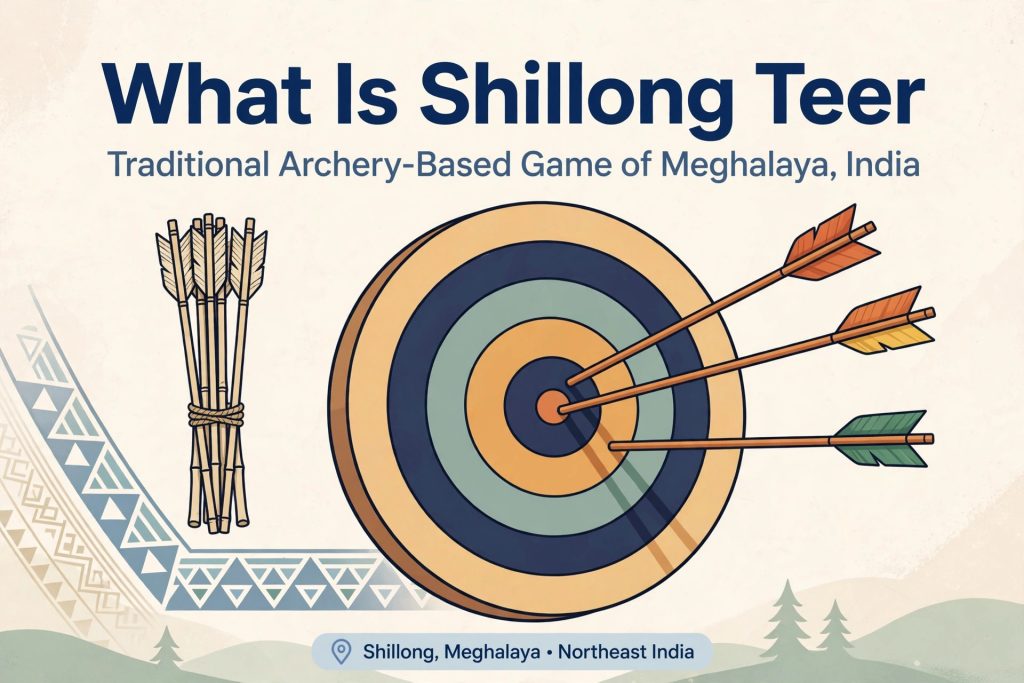
If you are asking what is Shillong Teer, here is the short answer before we go deeper. Shillong Teer is a legal lottery game played in Meghalaya, India, where the winning numbers are decided by a live archery contest. Skilled archers shoot arrows at a target in front of officials and spectators, the arrows that hit the target are counted, and the last two digits of that count become the result. Players buy tickets showing a number from 00 to 99, and a ticket that matches the declared number wins. That is the whole idea, and this beginner guide explains every part of it in plain language: the history, the rules, the two daily rounds, the legal status and how to follow the results responsibly. Teer is for adults aged 18 and above only, and it should always be treated as entertainment, never as a way to earn money.
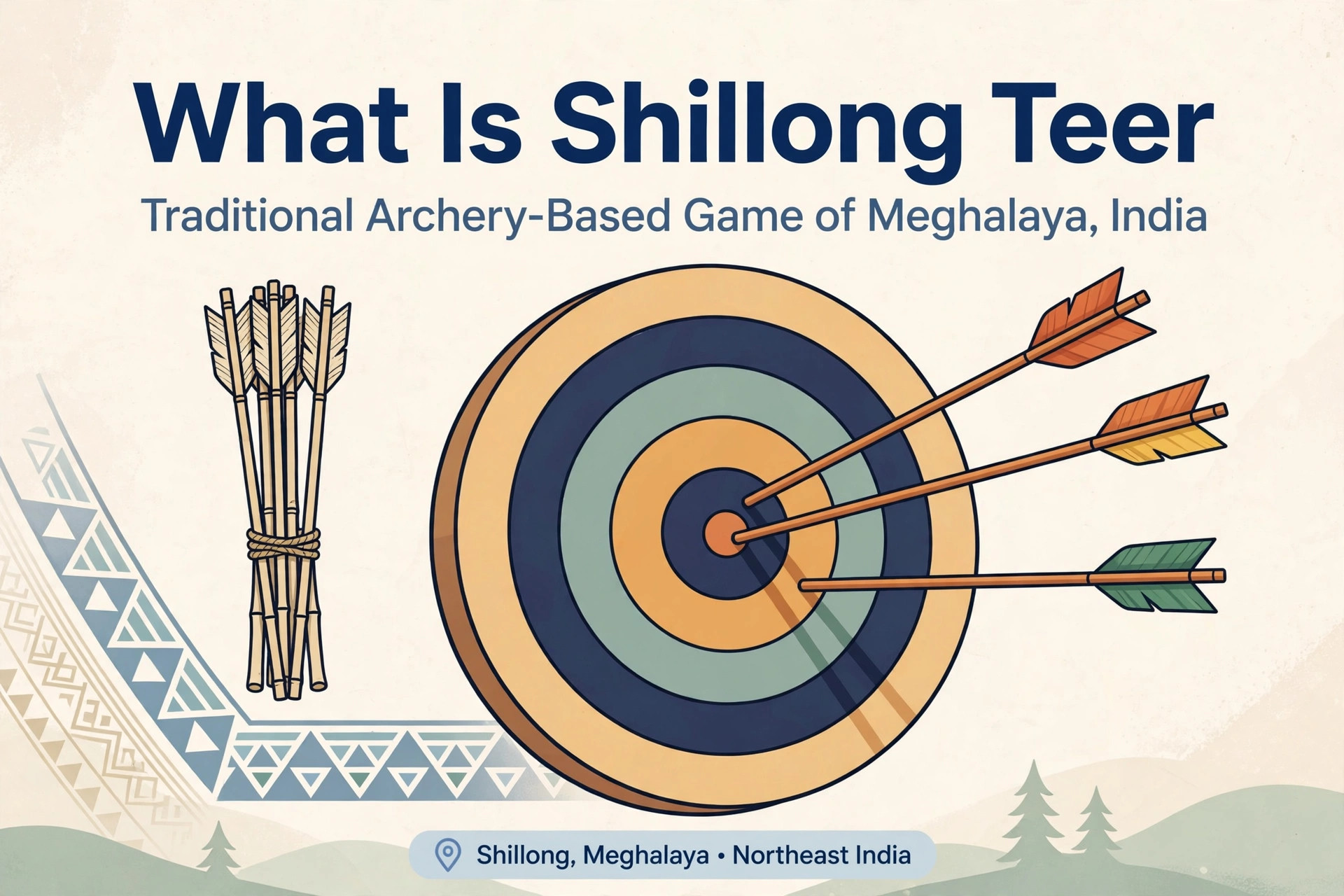
What Is Shillong Teer – A Simple Explanation
Let us start with the basics of what is Shillong Teer as a game you can actually picture. Every working day, members of licensed archery clubs gather at a shooting ground in Shillong. Spectators purchase tickets at authorised counters, each ticket carrying a two digit number between 00 and 99. The archers then shoot a fixed number of arrows at a cylindrical bamboo target from a set distance. When the shooting ends, officials count the arrows that struck the target. Only the last two digits of that count decide the winning number for the round.
Here is a simple illustration of the idea. Example only, not a real result: if the officials count 1,243 arrows in the target, the last two digits are 43, so the result is 43. If they count 862 arrows, the result is 62. Any ticket showing that number wins the round. The game is that direct.
The word “teer” comes from the Hindi and Bengali word for arrow, which tells you where the heart of the game lies. Unlike most lotteries, where a machine or a computer produces the number, Shillong Teer produces its number through a physical sporting event. The archery is not decoration. It is the mechanism of the draw itself, performed in public and watched by the crowd.
The game is not run by one private company. It is organised by archery clubs and associations that are licensed and supervised under the laws of Meghalaya. The venue, the schedule, the officials and the ticket counters all operate inside a legal framework, and the state collects tax on the activity. This is what makes Shillong Teer different from unregulated number games. It is a traditional sport formalised into a regulated lottery, and the archery clubs use their share of the proceeds to maintain the sport and support the archers.
Shillong Teer History – From Tradition to Legal Lottery
To understand the teer game fully, it helps to know where it came from. The story of shillong teer history begins centuries before tickets and result websites existed.
Archery has been part of Khasi culture in Meghalaya for generations. The Khasi people, the largest ethnic group in the state, traditionally used the bow and arrow for hunting and protection, and competitive shooting became a celebrated community event during festivals and gatherings. Archery contests were social occasions where whole villages would gather to watch and cheer.
As Shillong grew through the twentieth century, these contests grew with it. Spectators began staking money on the outcomes, informally at first. Local clubs started to organise the events more formally, collecting money and paying out winners. For a long time the game operated in a grey area: widely played and culturally accepted, but without official legal status.
The turning point came when the Government of Meghalaya decided to bring the game into the legal fold. Through the Meghalaya Amusement and Betting Tax Act, the state created a system to license archery clubs to run the game and to tax the betting activity. The informal contests became a regulated lottery. The archery stayed, the wagering stayed, but both now operate inside a published legal structure with accountable organisers. In a real sense, the old tribal tradition now funds the very sport it is based on, because the clubs reinvest in archery itself.
You can read more about the city and its archery heritage on the Wikipedia page about Shillong (https://en.wikipedia.org/wiki/Shillong), which describes the cultural background that produced the game.

How Teer Works – The Rules of the Game
Once you know the background, the next question is how teer works in practice. The game follows the same routine every day, and it breaks down into four clear steps.
Step 1 – Buying a ticket
Teer tickets are sold at authorised counters in Meghalaya. Each ticket shows a two digit number from 00 to 99, and the ticket price is kept small by the organising associations. A player selects one or more numbers and pays for each ticket. Tickets are bought in person at counters on the day of the game, before the shooting for each round begins. Sales close shortly before the archers start, and the cutoff is strict.
A point beginners often get wrong is the idea of playing online. The official game has no online ticket sale. Websites that publish results only display information. They do not sell tickets and are not part of the betting system. This site, Teer Results, is one such information site: it publishes daily results and educational guides, but it has no connection to ticket sales.
Step 2 – The shooting session
At the scheduled time, the archers take their positions at a measured distance from the target. The target is a cylindrical bundle of straw or hay in which arrows can stick. A fixed number of archers take part in each round, and each archer shoots a fixed number of arrows. The archers shoot in volleys while spectators watch from behind barriers and officials supervise. When all arrows have been shot, the round ends and no further shooting is allowed.
Step 3 – Counting the arrows
Counting is carried out by official counters under supervision, often in full view of the audience. Every arrow that struck the target and stayed in it is counted. Arrows that missed or fell out are excluded. The final count is announced publicly, and the last two digits become the official result for the round.
Step 4 – Winning and payouts
If the number on your ticket matches the announced result for that round, you win. The prize is calculated as a multiple of the ticket price, and payouts are made at the counters after the result is declared. Winners must claim within the time limit set by the organising association, usually the same day or within a short window. Keep your ticket safe, because it is the only proof of a win.

What Is Shillong Teer FR and SR – The Two Daily Rounds
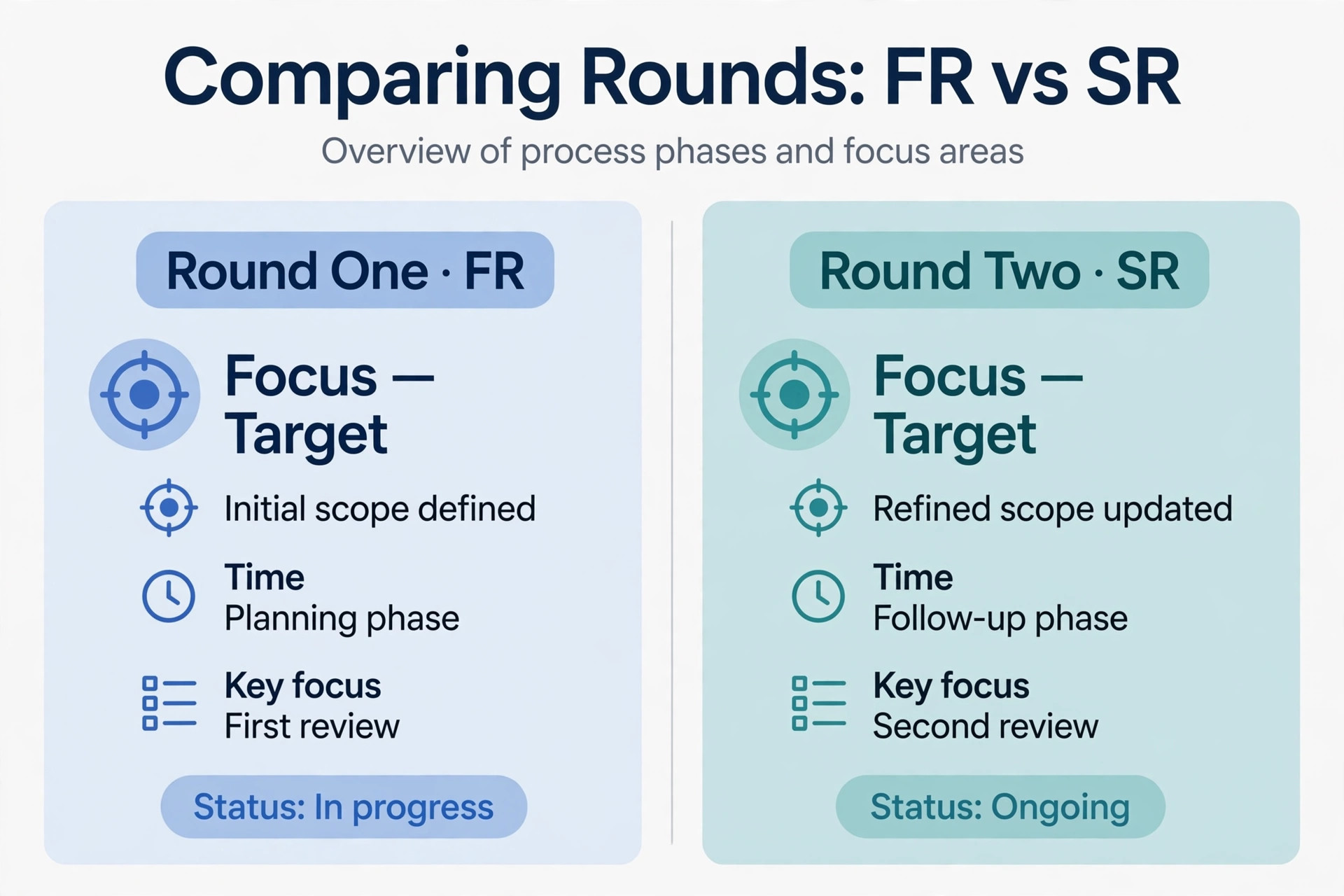
Every Shillong Teer day has two rounds, and understanding them answers a big part of what is Shillong Teer as a daily event. FR stands for First Round and SR stands for Second Round.
In the first round, the archers shoot one complete session, the arrows are counted, and the last two digits of the count become the FR result. After a break, the archers shoot again in a second session. The arrows are counted the same way, and the last two digits become the SR result. These two rounds are completely independent. The FR count has no effect on the SR count, and each round has its own ticket sales, its own result, its own winners and its own payout.
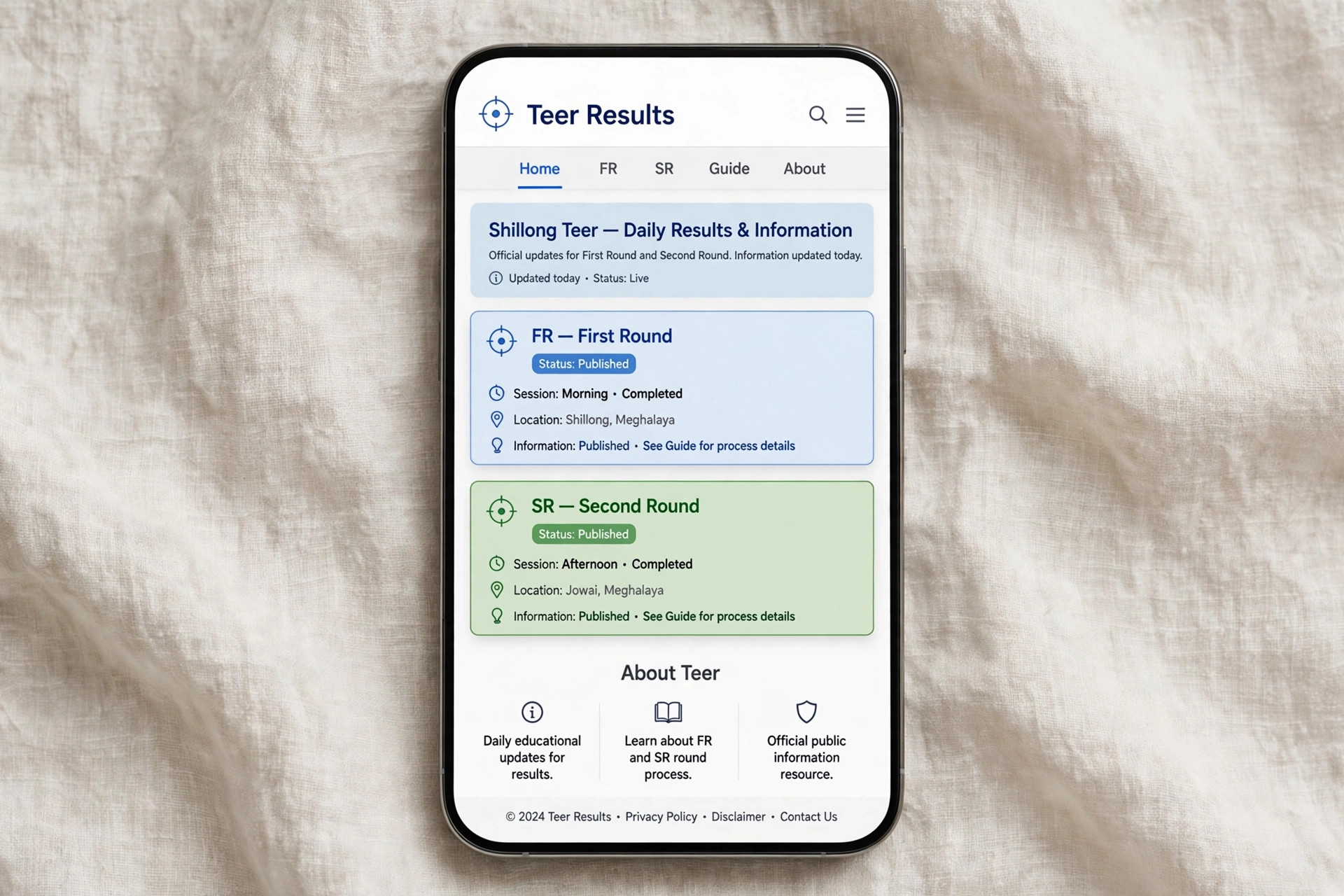
You can buy a ticket for the first round, the second round, or both. When people say “Shillong Teer result today,” they usually mean both numbers: the FR result and the SR result for that day.
The daily schedule
The Shillong day sessions normally take place in the afternoon and evening, six days a week. The game is traditionally not held on Sundays, and public holidays are also observed. The exact declaration timings can shift from time to time, so it is best to check the schedule on the day rather than memorising a fixed clock time. What stays constant is the format: two rounds, one day, two results.
Each round’s result is published as soon as the official count is complete. Before declaration, result pages show a placeholder such as “-” to indicate the number is not yet available. This site never publishes invented numbers, and any source that presents made up digits as real results should not be trusted.
Is Shillong Teer Legal
One of the most common questions after what is Shillong Teer is whether the game is legal. The answer is yes, in Meghalaya. Shillong Teer is a legal, state regulated lottery.
The game operates under the Meghalaya Amusement and Betting Tax Act, which allows licensed archery clubs to organise betting around their archery events and requires them to pay tax on it to the state government. This makes teer one of the few legal forms of betting in India, alongside state lotteries and licensed horse racing. The official portal of the Government of Meghalaya (https://meghalaya.gov.in/) is the authoritative source for state legislation and government notifications.
It is important to understand the limits of this legal status. The licence covers the physical game in Meghalaya: the counters, the shooting ground, the tickets and the payouts. Result websites are information services, not part of the betting system. Be cautious of any website or app that claims to sell teer tickets online or asks you to send money for participation. These are not part of the official game.
Gambling laws also differ across Indian states. Teer is legal in Meghalaya under the state act described above. If you live elsewhere, the legal position of participating may differ, and you should check your own state’s rules before taking part.
Shillong Teer vs Juwai and Khanapara Teer
Beginners often see several teer markets on a results page and wonder how they differ. The gameplay is the same everywhere: archers shoot, arrows are counted, and the last two digits decide the number. The differences are the venue, the organising associations, the schedule and the results, which are completely separate from each other.
Shillong Teer is the original game, played in the state capital of Meghalaya. It is the most followed market and the one most people mean when they talk about teer. You can follow it on the Shillong Teer result page.
Juwai Teer is played in Jowai in the West Jaintia Hills district of Meghalaya. It follows the same archery format and the same FR and SR structure but runs on its own schedule through local associations. Its numbers are published separately on the Juwai Teer result page.
Khanapara Teer is played at Khanapara near Guwahati in Assam, also under the Meghalaya framework, with its own daily FR and SR sessions.
A winning number in Shillong has no connection to the winning number in Juwai or Khanapara on the same day. Each market is its own game with its own archers and its own count. If you follow more than one market, always check that you are reading the correct section for the market you want. The teer result list page keeps every market and round clearly labelled so the numbers never get mixed up.
How to Check Shillong Teer Results Online
Most followers check the results online rather than at the venue. Here is how a beginner can do it reliably, step by step.
Step 1 – Use a trusted result site. Open a dedicated teer result website that updates daily, such as this site’s homepage. Bookmark it so you always land on the same reliable page.
Step 2 – Confirm the date and the market. Make sure the page shows the current date and that you are looking at the Shillong section, not Juwai or Khanapara.
Step 3 – Read the FR and SR numbers separately. The first round number is labelled FR and the second round number is labelled SR. Both appear once each round is officially declared.
Step 4 – Wait if the round is pending. If a round shows a placeholder or is marked pending, the official count has not been announced yet. Wait and refresh later rather than trusting numbers shared in messaging groups.
Step 5 – Use the archive for past dates. If you need an older number, use the archive or list page. Past results are useful as history, but remember that they cannot predict future numbers, because every round is a fresh physical event.
A warning that every beginner should hear: no website can know the result before the arrows are counted, because the result does not exist until the shooting is over. Anyone claiming to have the number in advance is not telling the truth. That is also why you will never find prediction content on this site: no common numbers, no hit numbers, no target numbers, and no house or ending tips. Honest result sites report what happened, nothing more.
Common Beginner Questions Answered
Here are a few more things newcomers often ask once they understand the basics of the teer game.
How long does a round take? A shooting session, including the counting, typically takes under an hour. The full day’s programme, with the break between FR and SR, spans the afternoon and evening.
Can the FR and SR numbers be the same? Yes. The rounds are independent, so it is possible for both rounds to produce the same number on the same day. It is uncommon, but it happens.
What happens in bad weather? Teer is an outdoor event, so severe weather can delay a round. Sessions may start late or be rescheduled, and result pages will show the round as pending until the official announcement comes through. Delays are normal and do not mean anything is wrong with the game.
Do the archers know the count while shooting? The archers concentrate on shooting, not counting. The official count happens after the round ends, under supervision, so nobody knows the final number until the counting is done.
Is there any skill in picking a number? The result comes from a live archery event, and no method can predict how many arrows will hit the target. Choosing numbers is a matter of personal preference and luck. This is exactly why responsible play matters so much.
A Note on Responsible Play
Teer is a legal lottery in Meghalaya, for adults aged 18 and above only. Legal and safe are not the same thing. Every ticket is money spent with no guarantee of return, and the likely outcome of any single ticket is that it wins nothing. Play only with money you can afford to lose completely. Set a budget before you start and stop when it is gone. Never borrow money to play, never chase losses by buying more tickets, and never let playing interfere with your responsibilities or relationships. If playing stops being fun, stop playing. If you notice warning signs in yourself, such as spending more than planned or thinking about the next round constantly, speak to someone you trust.
Frequently Asked Questions
What is Shillong Teer in simple words?
Shillong Teer is a legal archery based lottery held every working day in Shillong, Meghalaya. Archers shoot arrows at a target in two daily rounds, officials count the arrows that hit, and the last two digits of the count become the winning number. Players buy low cost tickets showing a number from 00 to 99, and a ticket matching the declared number wins the round.
What is the history of Shillong Teer?
Shillong Teer grew out of the traditional archery culture of the Khasi community of Meghalaya, where competitive shooting was a long standing community event. As betting interest around the contests grew, the game was organised more formally and later brought under the Meghalaya Amusement and Betting Tax Act, which licenses archery clubs to run it and taxes the activity. It is now a regulated state lottery that also supports the sport of archery.
How does the teer game work?
The teer game works in four steps. First, players buy tickets showing a two digit number from 00 to 99 at authorised counters. Second, archers shoot a fixed number of arrows at a target in front of officials and spectators. Third, officials count the arrows that struck the target. Fourth, the last two digits of the count are announced as the result. A ticket matching that number wins the round.
What are FR and SR in Shillong Teer?
FR stands for First Round and SR stands for Second Round. Shillong Teer is played in two rounds each day. In the first round, archers shoot once and the last two digits of the arrow count become the FR result. After a break, they shoot again and the last two digits of the second count become the SR result. The two rounds are independent, and each has its own winners.
Is Shillong Teer legal in India?
Shillong Teer is legal in Meghalaya, where it operates under the Meghalaya Amusement and Betting Tax Act with licences issued to archery clubs and associations. It is one of the few legal forms of betting in India. Gambling laws differ by state, so people outside Meghalaya should check their own state’s rules. Result websites only publish information and are not part of the betting system.
How can I check the Shillong Teer result?
You can check the Shillong Teer result on dedicated result websites that publish the daily FR and SR numbers once each round is officially declared. Look for the current date, confirm you are viewing the Shillong market, and read the FR and SR numbers separately. If a round is still pending, wait for the official declaration rather than trusting unofficial posts on social media.
What is the difference between Shillong, Juwai and Khanapara Teer?
They are three separate markets that play the same game in different places. Shillong Teer is played in the Meghalaya capital, Juwai Teer in Jowai in the West Jaintia Hills, and Khanapara Teer near Guwahati in Assam. Each has its own archery associations, schedule and results. A winning number in one market has no connection to the numbers in the others.
Can I buy Shillong Teer tickets online?
No. The official game sells tickets only through physical counters in Meghalaya. There is no official online ticket sale. Websites that publish teer results only display the declared numbers and guides. They do not sell tickets. Be cautious of any site or app that asks you to send money for teer tickets online, as these are not part of the official game.
What does the result number actually mean?
The result number is the last two digits of the total arrows that hit the target in that round. Example only, not a real result: if 1,105 arrows hit, the result is 05. It is a record of a completed archery session. Past results do not affect future rounds, because every session is a new physical event with a fresh count.
Is Shillong Teer safe for beginners to follow?
Following the results as a spectator is harmless entertainment. If you choose to buy a ticket, remember the game is for adults aged 18 and above only. Treat it as entertainment, set a spending limit, never chase losses, and stop if it stops being fun. Never trust anyone selling advance numbers or predictions, because the result cannot be known before the shooting ends.
Conclusion
Now you know what is Shillong Teer in full: a legal archery lottery from Meghalaya where the winning number comes from counting arrows, not drawing balls. You know its roots in Khasi archery tradition, how tickets, shooting, counting and payouts work, what FR and SR mean, and how to check results safely online. The game is simple at its core, and that simplicity is a large part of its appeal.
If you found this guide useful, bookmark the Teer Results homepage and visit the Shillong Teer result page to see the format you have just learned about in action. Whether you follow as a curious spectator or take part at the counters, keep the full picture in mind: a traditional sport, a regulated game, and entertainment for adults that should always stay fun.