
The assam teer result raises the same questions again and again: what the game is, where it is played, when the numbers come out, how a round of archery becomes a two-digit figure, and whether the whole thing is legal. This guide answers all of them in one place, in depth, so you never need to piece the picture together from fragments. It is written for the curious newcomer, the regular player who wants to be sure they have the details right, and anyone who has ever forwarded a result screenshot without quite knowing what it meant.
If you are here for today’s declared numbers, our Khanapara teer result page carries the latest FR and SR figures with their session labels. Everything below explains what those figures are and how to use them wisely.

What exactly is the assam teer result
Strip away everything else and the definition is simple. The assam teer result is the declared outcome of an archery-based lottery held at Khanapara, on the outskirts of Guwahati in Assam. Skilled archers shoot arrows at a target during a fixed shooting window. Officials count how many arrows strike the target. The last two digits of that count become the result, a number between 00 and 99. The game is a legal lottery conducted under Meghalaya state law, run by licensed organizing clubs, and restricted to adults aged 18 and above.
The phrase “Assam teer” is a geographic label, not a separate sport. It means the teer market at Khanapara in Assam, just as “Shillong teer” means the market at the Polo Ground in Shillong and “Juwai teer” means the market in the Jaintia Hills. Searches for assam teer, teer result assam, assam teer result today and guwahati teer result all point to the same Khanapara game, and the assam teer list that result sites publish is the archive of its daily declared figures.
Why archery
The game is built on traditional Khasi archery, a skill passed down through generations in the hill region. The archers use traditional bamboo bows, shoot from a fixed distance, and loose their arrows in rapid succession. The point of using human archers instead of a machine draw is that the outcome is produced in the open, in front of witnesses, through a display of skill whose exact result nobody can fix in advance. That transparency is the whole basis of the game’s credibility.
The people who make it happen
Each day’s game is run by a licensed organizing club: a committee that oversees the program, marshals who manage the shooting line, independent counters who record the arrows that hit the target, and a network of licensed ticket counters and agents who handle sales. The club operates under a state licence with defined obligations covering the ground, the equipment, the timings, the counting, the records and the payouts. The archers are practitioners of the traditional style, and the separation between the people who shoot and the people who count is deliberate: it protects the integrity of every declared figure.
The complete daily schedule – sessions, FR and SR
The single most useful thing to understand about the assam teer result is the structure of the day. The Khanapara market does not declare one number per day. It runs a program of sessions, and each session declares two numbers.
Morning and afternoon sessions
The Khanapara program is divided into a morning session and a regular afternoon session. The morning session is the earlier program of the day, and the afternoon session is the main event that most players follow. Each session is a complete mini-program with its own first round and second round, so a full day of Assam teer produces four headline figures: morning FR, morning SR, afternoon FR and afternoon SR. Our Khanapara morning teer result page presents the morning program on its own, clearly separated from the afternoon figures.

FR and SR – the two rounds
FR stands for first round and SR stands for second round. In each session, the archers first shoot the FR: a full shooting window, then a count, then a declared two-digit number. After a break, they shoot the SR: a fresh shooting window, a fresh count, and a fresh declared number. The SR has no mathematical relationship to the FR. They are two independent archery rounds, and tickets are sold separately for each. When you see a result card showing FR and SR side by side, you are looking at the outcomes of two separate rounds of shooting.
When results are declared
Results are declared at fixed times on each working day, and the rhythm is worth memorizing. The morning session declares its rounds in the earlier part of the day. The afternoon session declares its FR in the afternoon and its SR in the evening. These timings are part of the licensed schedule announced by the organizers. Knowing them matters because a result only means something in its correct slot: the afternoon FR figure checked at the morning FR’s hour is the wrong number, and mixing sessions is the most common beginner error in the entire teer world.
Days with no play
Teer is an outdoor sport and a regulated activity, so there are days when no rounds take place. Heavy weather can make the ground unsafe, public holidays can suspend play, and administrative decisions can pause the program. On such days there is no result to declare, and reliable sources show the round as cancelled or pending. Any site that publishes a “result” for a day with no play is not a source you should trust.
From the first arrow to the declared number – how a round works
This section answers the question players ask most after “when”: how does a shower of arrows become a number on a screen.
The shooting window
The archers take their positions at the shooting line while officials confirm that the target area is clear and the conditions are acceptable. On the signal, the shooting window opens. Each archer looses arrows at the target as rapidly as the traditional technique allows, aiming for consistency over the whole window rather than any single perfect shot. Spectators watch from the designated areas, and the marshals keep the safety perimeter clear. When the window closes, shooting stops immediately. Arrows loosed after the signal do not count.
The count
Counters then examine the target and tally every arrow that struck it. This is done in the open, under the supervision of the officials, and the count is agreed before anything is announced. The total number of striking arrows is recorded as the round’s count. The result is derived from this count by taking its last two digits. That is the entire transformation: a physical count of arrows becomes a two-digit figure through a rule everyone knows in advance.
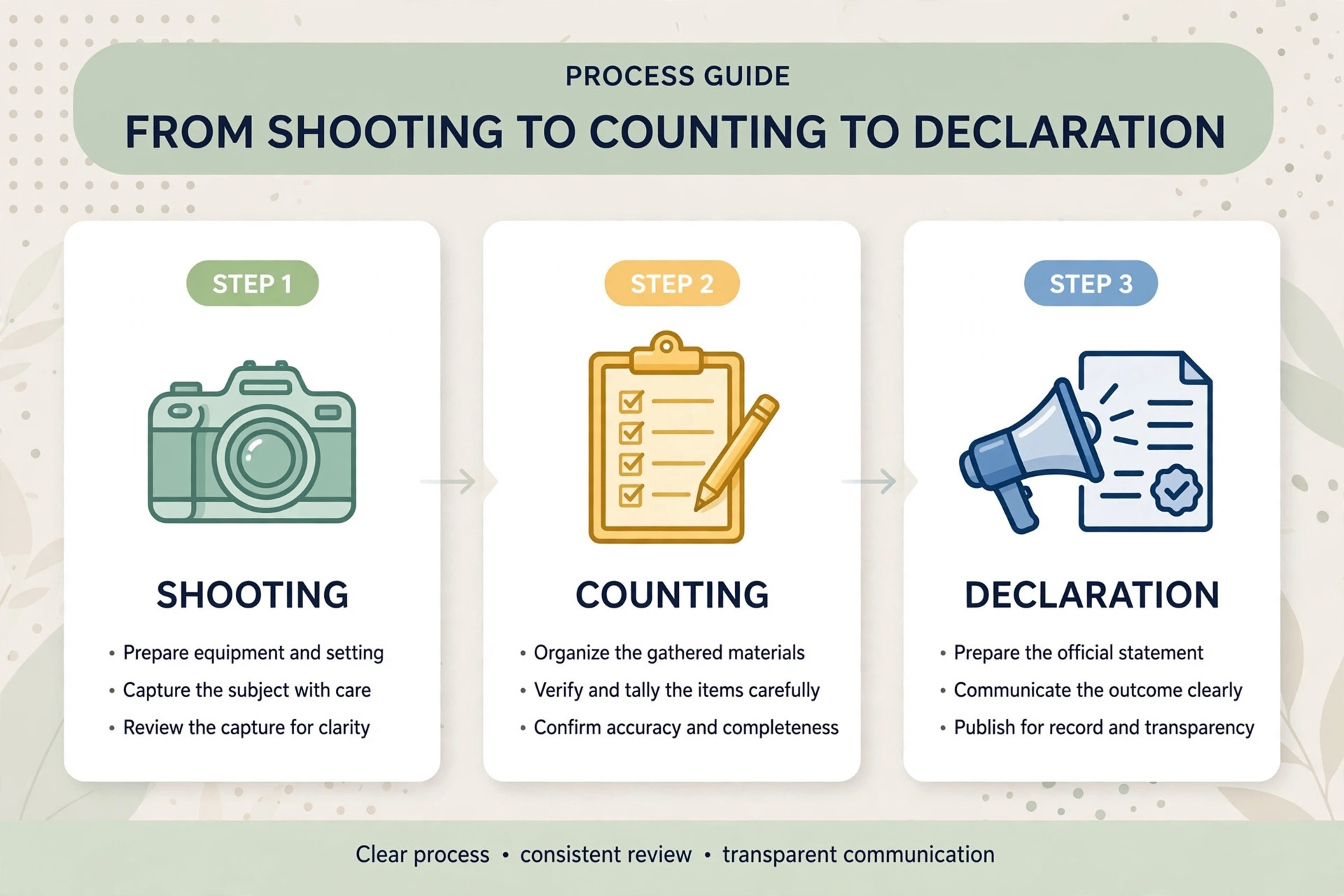
The declaration
The two-digit figure is announced at the ground and recorded by the organizers. From there it travels through the licensed network: to the ticket counters, to the agents, and to the result websites and publications that report it. A responsible result site labels every figure with its market, session, round and date, because a number without those labels is just a number. When you check the assam teer result on our teer result list page, you will see the full day’s program laid out with every label in place, and older days archived in date order behind it.
Why nobody can fix or predict it
The honest answer to every prediction question is physics. Even a master archer cannot control the exact number of arrows that will strike the target in a given window. Wind shifts, light changes, muscles tire, and no two bamboo arrows fly identically. Skill sets a plausible range, but the precise count is genuinely uncertain, which is exactly what makes the game a lottery rather than a performance. Anyone selling “lucky number” or prediction tips is selling fiction. The result is produced by the round, and the round cannot be predicted.
How to read the result – format, the dash, and derived figures
Reading a result card correctly is a small discipline that prevents expensive mistakes.
The two-digit format
Every declared result is a two-digit number from 00 to 99. That is the official figure, and it is what tickets are settled against. Keep this in mind when you see longer strings of digits on unofficial sites: the declared result is always the two-digit number.
What the dash means
Result sites commonly show a “-” in a slot where no figure is available yet. The dash is a placeholder. It means the round has not been declared, or the round did not take place. It is not a number, not a hint, not a signal, and not a prediction. Treat any interpretation of a dash as superstition.
House and ending – what the terms mean
You will sometimes see the words “house” and “ending” attached to teer results. In plain terms, for a two-digit result these refer to the first digit and the second digit respectively, and some players use them as shorthand when discussing or recording results. That is all they are: a vocabulary for talking about the digits. They confer no predictive power, and any paid prediction tip offered for sale is a scam by definition, because the digits come from an unpredictable archery round.
Verifying what you see
The teer result economy runs on screenshots, and screenshots are trivially easy to fake or misdate. Build one habit: never trust a forwarded image. Open a reliable source, check the date header on the card, confirm the market name says Khanapara or Assam teer, confirm the session and the round, and only then accept the figure. This thirty-second routine is the cheapest insurance in the game.

Tickets – how playing works
Understanding the result is only half the picture. Here is how participation works for the adult player.
Buying a ticket
Tickets are sold through licensed counters at the ground and through authorized agents in the surrounding areas. You choose your numbers for the FR or SR of a given session, pay the stake, and receive a ticket or receipt. Keep it safe: it is your proof of participation, and winnings are paid against it through the licensed network. Never buy from unlicensed sellers or through informal messaging-app bookies. A ticket outside the licensed chain is not part of the legal game.
How winnings work
Winnings are settled against the declared result for the round and session on your ticket. The payout structure is set by the licensed operation, and prizes are claimed through the counter or agent network within the stipulated time. Keep your ticket until the result is declared and verified, and claim promptly.
The 18-plus rule
Teer is strictly for adults aged 18 and above. This is not a suggestion; it is part of the regulated framework, and licensed counters are required to observe it. If you are under 18, teer is not for you.
The legal status of the assam teer result
Teer is a legal lottery in Meghalaya. The game operates under state legislation, including the Meghalaya Amusement and Betting Tax Act and the rules framed under it, which licence archery clubs to conduct teer, define how rounds must be run, and create the taxation and oversight structure around the game. You can explore the state’s official presence through the Meghalaya government portal. The Khanapara game functions within this framework: licensed organizers, declared schedules, supervised counting, recorded results, and tax paid on the operation.
This legal standing has three practical consequences for players. First, only figures declared through the licensed process are official. Second, winnings flow through the licensed network, which is why authorized counters and safe ticket-keeping matter. Third, the game can be reported openly, which is why legitimate result websites exist at all. The same legal framework is also what separates the real game from the many unauthorized operations that borrow the teer name for unlicensed betting, fake result announcements and number-selling scams. The real assam teer result always comes from the ground, through the licensed clubs.

Responsible play
A legal lottery is still a lottery, and lotteries cost money. Play only with funds you can afford to lose, decide your budget before you buy a ticket, and never chase losses by buying more. Treat teer as entertainment, not income. If it stops being fun, stop. Ignore every seller of guaranteed numbers: the only honest statement about the next round is that nobody knows its outcome. Keep tickets from licensed counters only, and verify every result against a dated, reliable source.
Expanded FAQ – the most asked questions about Assam teer
What is the assam teer result?
The assam teer result is the declared outcome of the archery-based lottery held at Khanapara near Guwahati in Assam. Each round’s result is a two-digit number derived from the count of arrows striking the target, announced for the FR and SR of each session.
Where is Assam teer played?
At the Khanapara ground on the southern outskirts of Guwahati, Assam, near the Assam-Meghalaya border. The ground hosts the morning session and the regular afternoon session of the Assam teer market.
What do FR and SR mean?
FR is the first round and SR is the second round of a session. Each is a separate archery round with its own shooting window, count and declared two-digit result. Tickets are sold separately for FR and SR.
How many results are declared per day?
On a full working day, four headline figures: morning FR, morning SR, afternoon FR and afternoon SR. Each comes from its own archery round.
When are the results declared?
At fixed times each working day. The morning session declares earlier in the day, the afternoon FR declares in the afternoon, and the afternoon SR declares in the evening. Check the Khanapara teer result page for the declared figures with their labels.
What does a dash mean in the result?
A dash is a placeholder showing that the round has not been declared yet or did not take place. It is not a result and not a prediction.
Is Assam teer the same as Shillong teer?
No. They are separate markets with separate grounds, organizers, sessions and results. Assam teer is the Khanapara game near Guwahati; Shillong teer is the Polo Ground game in Shillong. The mechanics are the same but the numbers are independent.
Is Assam teer legal?
Yes. Teer is a legal lottery in Meghalaya, conducted by licensed clubs under state law including the Meghalaya Amusement and Betting Tax Act. The Khanapara game operates within this licensing and taxation framework.
How do I buy a teer ticket?
From licensed counters at the ground or authorized agents. Choose your numbers for the FR or SR of a session, pay, and keep your ticket safe. Never buy from unlicensed sellers.
Who can play teer?
Adults aged 18 and above only. The age rule is part of the regulated framework.
Can the assam teer result be predicted?
No. The result comes from a live archery round under open conditions, and the exact arrow count cannot be predicted or controlled. All prediction claims are scams.
What should I do if a round is cancelled?
Nothing needs to be done. A cancelled round has no result, and no figure is declared. Do not trust any source that publishes a number for a cancelled round.
Where can I check old results?
Result archives keep previous days’ cards in date order. Our teer result list page maintains the chronological archive so you can review earlier sessions.
Why do forwarded result screenshots sometimes show wrong numbers?
Because screenshots are easy to edit, misdate or mislabel. Always verify against a reliable source showing the full dated card with market, session and round labels.
Conclusion
The assam teer result is not a mystery once you know the structure: a traditional archery ground at Khanapara, licensed clubs running morning and afternoon sessions, two independent rounds per session, open counting that turns arrows into a two-digit number, and a state legal framework that makes the whole thing official. Keep the sessions straight, read the card by its labels, verify the date, buy only from licensed counters, and play responsibly as an adult. For the latest declared figures, visit our Khanapara teer result page, browse the archive on the teer result list, or start from the Teer Results homepage for every market we cover.